Many schools host a career fair with stations for different fields, such as STEM, aerospace, and healthcare. Others hold conferences where professionals speak, and students sit through long lectures. Both cover the same familiar jobs: doctor, firefighter, teacher, engineer, and neither gives students much reason to picture themselves doing the work.
Those careers are not going anywhere, but the work inside them has changed. A firefighter now scouts a burning roof with a camera before anyone climbs it. An engineer spends more of the week in modeling software than on site. A student can’t judge whether that version of the job fits them by listening to someone describe it. They need to try it.
“We’ve found that activities tied to real careers—like flying drones, completing missions, or working as a team—create excitement that lasts long after career day,” says Chris Tonn, co-founder of Rocket Drones.
In this article, we will cover 14 career day ideas for classrooms, camps, and after-school programs, and how to make them memorable for students at any grade level.
1. Career Costume Parade
Ask students to dress up as the profession they want to pursue and parade around the school or playground. Add a fun twist by having teachers dress as what they wanted to be as kids. This works because young students learn through play and imagination.
2. Real Tool Try-It Stations
Set up stations where students use a professional’s tool to finish a small task. Future doctors find a heartbeat and count the beats in fifteen seconds. Future scientists load a prepared slide and describe what they see under the lens.
The task is what teaches, since a tool means nothing until a student uses it for something. Ask local professionals to bring their own equipment and set the task themselves. They know which small job represents the work best.
3. Build-a-Business Pitch Activity
Give students a worksheet to brainstorm a business idea, set a budget, and pitch it to the group. This introduces entrepreneurship in a way that feels like a game. Offering small prizes for the most creative pitch keeps the energy competitive and fun.
4. Bring a Professional Day
Invite local professionals to give short talks, then let students ask direct questions. Encourage speakers to share what a normal day looks like. Hearing real stories helps students picture themselves in that role.
You can also invite parents who work in professional fields, since elementary and middle school students love seeing a familiar face step into the “expert” role.
5. Career Case File Challenge
Give small teams a “case” to solve using the actual skills a career requires, like decoding a message for a cybersecurity role or analyzing evidence for a forensic science role. Students work through real clues instead of listening to a description of the job. This format works well for elementary through middle school students who like problem-solving.
6. Skit and Roleplay Performances
Have small groups write and act out a short skit set in a workplace, showing a normal day or a tricky problem on the job. Acting it out teaches students what a career actually involves. This idea works especially well for older elementary and middle schoolers who enjoy performing.
7. Beginner Coding Workshop
Bring in a software engineer to run a short session using a beginner platform like Scratch or Blockly. Students build a simple game or animation in under an hour. This makes tech careers feel accessible, especially for kids who have never coded before.
8. Drone Simulator Competition
A simulator station needs a laptop and a controller, which makes it the easiest drone activity to run at a career day.
You can run all students through the same course one at a time and give each of them two attempts, which takes about three minutes per student. Score them on speed and on gate misses instead of speed alone, since scoring both ways gives the careful pilot a win the fast one doesn’t get. Put the leaderboard where students waiting in line can see it. Watching someone else’s run is how they figure out what to do differently on their own.
Rocket Drones offers a drone simulator program with a beginner mode and a racing mode, so one station handles a mixed group of grades.
9. Remote Piloting and Robotics Station
Give students a vehicle they control remotely and set up a mission, like navigating an obstacle course or completing a delivery task. This connects to careers in engineering, logistics, and robotics. Kids get to practice hand-eye coordination and problem-solving while thinking about jobs that rely on operating machines from a distance.
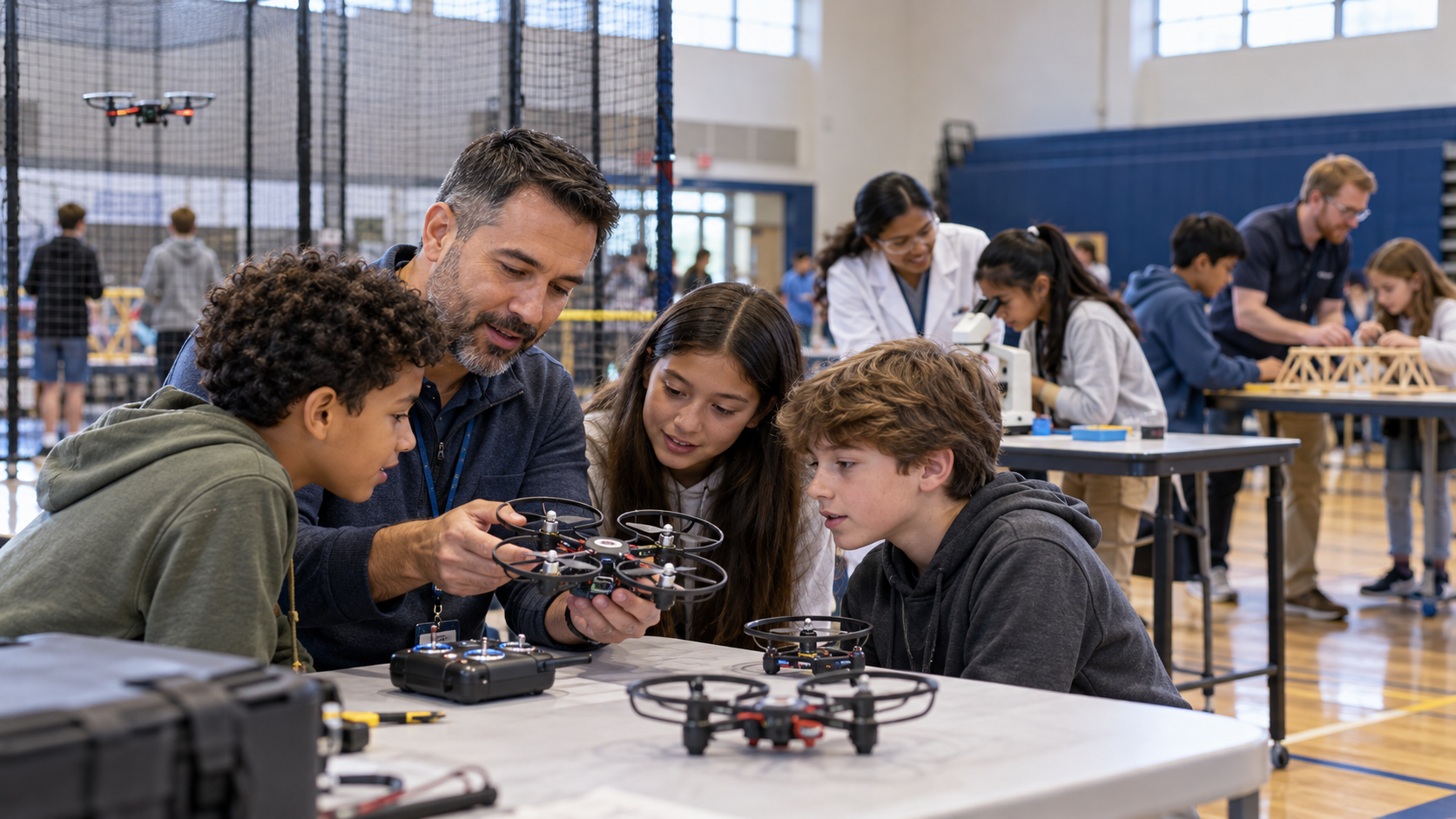
Rocket Drones offers a drone classroom kit built for this activity. We provide six ready-to-fly drones, a mini obstacle course, and flight challenges like box flights and slalom. You can add team missions, racing challenges, and simulator competitions that showcase how drones are used in industries like public safety, construction, agriculture, filmmaking, and engineering.
10. Emergency Response Simulation
Create a scenario where students act as first responders assessing a “disaster” area from above before sending in a ground team. This ties into careers in public safety, search and rescue, and emergency management. It shows students how technology helps first responders make faster, safer decisions in real emergencies.
Many students like to get hands-on experience. You can invite professionals from the rescue and operations teams to plan this activity, so they work in real time.
You can also introduce drone technology. Rocket Drones helps students see how drones are used in search and rescue operations. Students can learn about disaster zone monitoring, locating missing persons, and supply delivery.
11. Photography Station
Set up a station where students take photos or video from a raised platform or ladder to capture their school or playground from above. This helps them connect to careers in photography, filmmaking, and real estate. It is a simple, visual way to show students how professionals use a different vantage point to do their jobs.
12. Science Experiment Led by a STEM Professional
Invite a water quality engineer to run the same test they do at work. Your students compare tap water to pond water for pH and cloudiness, taking the readings themselves while the engineer explains what each number means. It’s the same check that happens before a treatment plant releases anything.
Then have the engineer walk through what happens when a reading comes back wrong. Students learn the job involves judgment and not just following steps.
Your local water utility or a university extension office can usually send someone, since most have staff whose job includes school visits.
13. Precision Challenge
Set up a mock field using a grid on the floor or a large poster, with colored markers showing “problem spots.” Students work in teams to scan the field and mark the problem areas on a chart. This connects to real careers in agriculture, where workers monitor crop health before deciding where to focus.
Rocket Drones’ drone curriculum covers aerial monitoring skills within a broader unit on drone use applications. Students can use drones to inspect the field, so they experience how the technology works in real use cases.
14. Site Inspection Activity
Give students a small aerial device to check a model building or job site for hazards, like missing safety gear or blocked exits, before clearing it for work. This ties into construction careers, where inspectors use aerial views to check job sites without needing scaffolding or ladders.
Rocket Drones’ classroom kit includes altitude and box-flight challenges that students can play and learn about inspection skills needed in construction.
Make Career Day Memorable With Practical, Fun Activities
A single career day can influence how a student sees their future, but only if they experience that career firsthand. When students get to solve a problem, complete a challenge, or use real technology, they become active participants instead of passive listeners.
Drones are just one of the many practical tools that allow students to learn and engage with their area of interest through simulation and training.
Rocket Drones offers hands-on drone experience and training for grades 3 through 12. Students can try out the drone racing kit and simulator to experience flying drones during the career day. We provide curriculum, scenario-based training, and certification exam prep that integrate into your CTE programs or summer camps for all grade levels.
Contact us to bring a drone station to your next career day and give students a career they can actually try.
Frequently Asked Questions
How far in advance should you start planning a career day?
How to run career day activities across mixed grade levels in the same event?
Can career day be organized around specific career clusters instead of individual stations?
Do hands-on drone activities require a gym, outdoor space, or special equipment?
How to measure career day success among students?
Drone
Competition
2027
Aerial Perspectives Podcast

Discover the exciting world of drones with Aerial Perspectives! Each episode takes you behind the scenes with drone pilots from diverse industries–cinematography, construction, inspection, agriculture, and more.