Drones in Search and Rescue: How the Technology Works and Where the Jobs Are
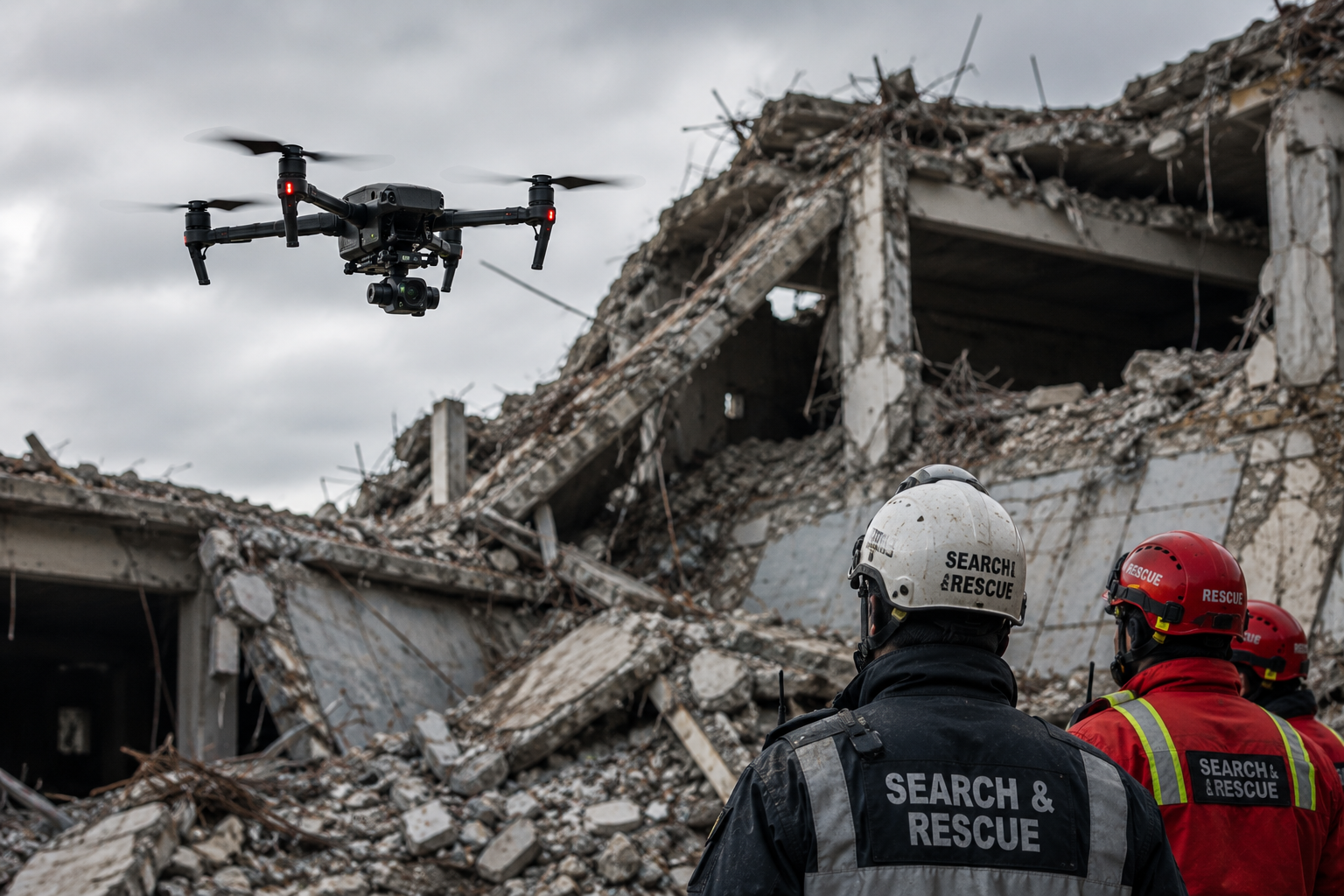
A hiker went missing in the North Shore Mountains, Vancouver, Canada. Temperatures dropped to -6°C, and the dense forest limited search. A drone found him huddled under a tree, hypothermic from falling into creeks. The search team was able to locate him without wasting resources, which saved his life.
But that outcome didn’t happen because of the drone alone. The operator had to scan unfamiliar terrain, read a thermal feed, and direct ground crews fast enough. Most certified pilots can’t do that. It takes manual flight skill, real-time decision-making, and hours of practice that few candidates bring to the table. Agencies know it, and they’re actively looking for people who can.
This article covers how drones in search and rescue work, what it takes to fly one in the field, and why this is one of the most accessible career paths for high school students.
Key Takeaways
- Search and rescue drones use thermal imaging, live video feeds, and payload drop systems to support missions that ground teams can’t execute alone.
- Agencies need drones to locate people, assess hazards, monitor disaster areas, and deliver emergency supplies faster.
- Qualified SAR pilots find job opportunities across law enforcement, fire rescue, emergency management, and wildlife agencies.
- FAA Part 107 is the baseline credential, but agencies hire for manual flight proficiency, situational awareness, and performance under pressure.
- The NIST drone challenge is a hands-on skills benchmark that many public safety agencies reference beyond the written exam.
- Students who log real flight hours and build a portfolio before graduation enter the hiring pool ahead of most candidates.
How Do Drones in Search and Rescue Work?
Search and rescue drones are small unmanned aircraft equipped with cameras and sensors. They lift off in minutes and can cover large terrains that would take a ground team hours to reach.
SAR drones use thermal imaging to capture heat. Every living body emits warmth, and the thermal camera reads that as a bright signature against a cooler background. This helps teams find survivors in dense forests, heavy smoke, and complete darkness.
The drones also use live video transmission. The pilot tracks a real-time feed on a screen and relays exact coordinates to the response team on the ground. Ground crews stop searching blindly and move in with a precise target.
How Drones are Used in Search and Rescue Operations
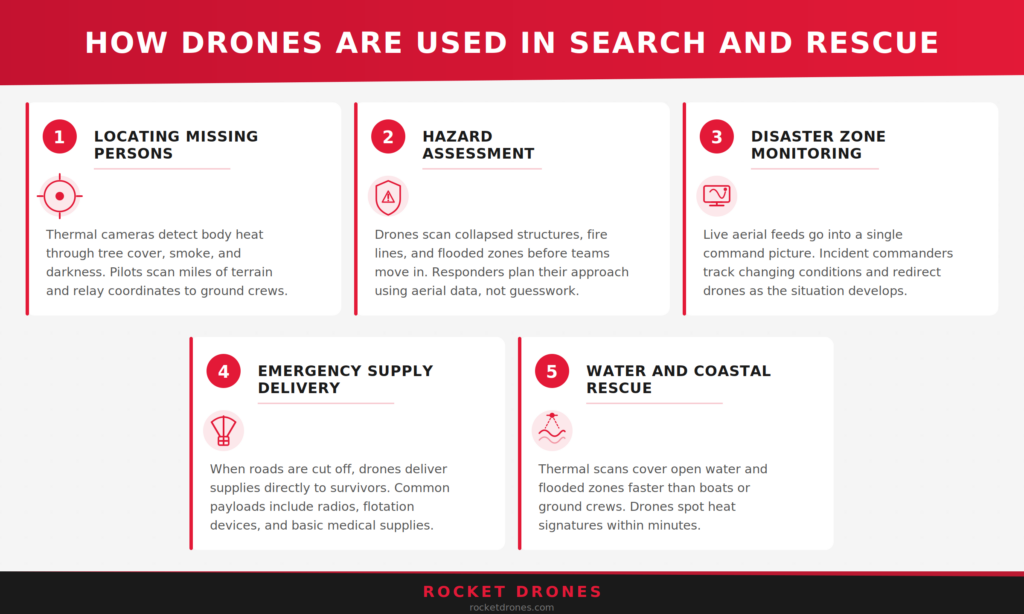
SAR teams currently deploy drones across five core mission types:
Locating Missing Persons
A SAR drone can cover miles of wilderness, coastline, or dense terrain. The teams calculate where to search based on the last known location and terrain type. The pilot selects a flight pattern from there.
The thermal camera picks up body heat through tree cover and darkness, giving the pilot a precise location to hand off to ground crews.
Hazard Assessment
Ground teams don’t move into an unknown area blind. Drones go in first, scanning collapsed structures, active fire lines, and flooded zones to identify risks before responders arrive. That information helps rescue teams plan their approach before entering the affected area.
Disaster Zone Monitoring
In active disaster zones, drone operators run continuous flights and feed live video into a single command picture. Incident commanders track conditions as they change and retask drones to different areas as the situation develops.
Emergency Supply Delivery
When roads are cut off, and ground teams can’t get through, drones carry supplies directly to survivors. Pilots attach a payload, fly to the target location, and release it on the ground. Common deliveries include radios, flotation devices, and basic medical supplies.
Water and Coastal Rescue
Drones cover open water faster than any ground or boat team. When a swimmer goes missing near a coastline or a flood cuts off access to a neighborhood, a drone with a thermal camera can scan the area and identify a heat signature within minutes.
Who is Qualified to Fly Search and Rescue Drones
Most agencies look for pilots with FAA (Federal Aviation Administration) Part 107 certification, which authorizes pilots to fly drones in the U.S. It covers airspace rules, weather interpretation, and flight planning.
But there’s a difference between being certified and being qualified. Part 107 proves you passed a test. It doesn’t test what happens when GPS degrades in a canyon, the control signal drops in dense forest, or conditions change mid-flight.
Agencies know this. So they look beyond the drone certificate.
They need operators who have strong manual flight skills, communication abilities, and experience operating in high-pressure environments.
A SAR pilot needs to read thermal feed, identify a heat signature, and relay precise coordinates to a ground team in real-time.
Many agencies also require pilots to complete the NIST drone challenge. It puts pilots through hands-on tasks such as navigating tight spaces, maintaining precise positioning, and flying under time pressure.
What Jobs Are Available for Search and Rescue Drone Operators
SAR drone piloting is part of a broader public safety career. A trained drone operator can pursue a career as a law enforcement officer, a firefighter, an emergency management coordinator, or a park ranger.
Here are a few specific areas where the demand for flying drones in search and rescue operations is growing:
- Law Enforcement: Police departments and sheriff’s offices need drones for missing persons searches, crime scene documentation, and disaster response.
- Fire and Rescue: Teams need drone operators for active fire monitoring, hazard assessment, and coordination with ground crews, which are in demand year-round, especially during wildfire seasons.
- Emergency Management: FEMA and state emergency management agencies coordinate drone operations during major disaster responses.
- Wildlife and Parks: Federal and state agencies need drone operators for wildlife surveys, habitat mapping, and search operations in remote terrain.
How Rocket Drones Help Students Develop Specialized SAR Drone Skills
Rocket Drones is a drone education company designed for students from grades 3 to 12. We combine curriculum, hands-on training, and portfolio development.
Our program builds the skills agencies actually hire for. Students log real flight hours, learn manual control, and graduate with a documented portfolio that proves field readiness beyond a written certificate.
Here’s how we prepare students with real-world applications:
Age-Appropriate Curriculum
The drone curriculum covers flight principles, drone anatomy, safety, regulations, and careers across every grade level. Younger students start with basics and gamified activities. Older students learn hands-on skills, develop a portfolio, and prepare for the FAA Part 107 certification exam.
Student Drone Certification Preparation
Students aged 16 and older can pursue FAA Part 107 certification through the program. The course covers airspace rules, weather, emergency procedures, crew communication, and aeronautical decision-making.
Students pair it with logged flight hours and manual training so they graduate qualified, not just certified.
Professional Portfolio Building
Drones students can log verified flight hours with structured challenges, build precision control, and practice without sensor assistance. Those hours go into a documented portfolio to stand out in a job application or agency evaluation.
Flexible Classroom Adoption
We work with your existing CTE programs without requiring new facilities or additional staff. You can run it as a fast-track course or spread it across a full semester, making it a practical option for districts of any size.
Give Your Students the Flight Skills SAR Agencies Are Hiring For
Agencies need operators with manual flight proficiency, communication skills, and experience operating in high-pressure environments. These skills take time to build.
Rocket Drones combines technology, teamwork, and real-world problem-solving skills into a structured program for grades 3 through 12. We build that preparation into your existing CTE program, so students graduate with a documented portfolio and credentials that SAR agencies actually hire for.Contact us to learn how Rocket Drones helps you implement a career-ready drone program in your school.
Frequently Asked Questions
What type of drone is used for search and rescue?
Do SAR agencies hire high school graduates?
Can school teachers teach drone programs for SAR use cases?
How does thermal imaging help find missing people?
What is the NIST drone challenge?
Drone
Competition
2027
⏰ Please sign up for the waitlist for 2027
Aerial Perspectives Podcast
Discover the exciting world of drones with Aerial Perspectives! Each episode takes you behind the scenes with drone pilots from diverse industries–cinematography, construction, inspection, agriculture, and more.