A third grader can name an astronaut, a doctor, and a firefighter without blinking. Some can even describe these jobs in detail.
A study shows that most elementary students under age 11 already have an interest or career aspiration. But this interest pool is limited based on their parent’s job, a TV character, or someone in their neighborhood. And their choice changes year after year.
Most schools don’t include career guidance for elementary students. They focus on worksheets, a dream-job drawing, or short essays like “when I grow up.” But these abstract activities rarely develop any practical skill or foundation. Young students need hands-on experiences to visualize and explore careers, so they follow the right pathway when they grow up.
This article covers why career exploration for elementary students should start early, how schools can make it practical, and where hands-on tools like drones fit into that picture.
Key Takeaways
- Career exploration for elementary students happens best through play. Kids build awareness of what jobs exist, without weighing career choices.
- Most elementary students already have a career interest, but it comes from limited sources like a parent’s job or a TV character.
- Hands-on tools beat worksheets and career talks because familiar controls, like a two-joystick controller, remove the learning curve.
- Drones turn abstract STEM concepts into something students can see and control, building spatial awareness and problem-solving through play.
- Early STEM confidence carries forward. Students who build interest young are more likely to pursue STEM seriously by high school.
- Rocket Drones provides a curriculum, drone kits, and gamified learning activities from grades 3 through 12, so young students develop interest in STEM and build foundational skills.
Why Career Exploration for Elementary Students Should Start Early
Elementary-aged children are naturally curious, making it the perfect time to build career awareness of what jobs exist and what people do in them.
Early exposure also helps break stereotypes tied to gender, race, or background in a child’s development. When students see diverse role models in engineering, science, or entrepreneurship, they picture themselves in similar roles.
But elementary students aren’t ready to weigh career options, and they don’t need to be. At this age, exposure matters more than decisions. A student flying a drone through a gamified activity, like drone basketball, a relay race, or a flight challenge, isn’t picking a career. They’re learning that technology is something they can operate and control.
This builds real confidence and ambition during a formative stage of learning. The students learn to connect subjects to the activity itself. For example, students learn that a vet uses science to keep animals healthy, or that a builder uses math to measure and plan.
As children connect schoolwork to actual careers, they naturally start noticing their own strengths and interests. A study found that students exposed to even one career-connected activity engaged with school more than students with none, and that gap widened with repeated exposure.
This engagement helps students build curiosity, confidence, and skills like goal-setting, problem-solving, and communication. They can carry these skills through their academic journey regardless of the career they pursue.
Why Hands-On Tools Beat Worksheets and Career Talks in Elementary Schools
Most elementary students have already used a game controller, a touchscreen, or a tablet before they ever walk into a STEM (science, technology, engineering, and math) classroom. Good programs use hands-on tools like drone technology that are built around the same familiar controls.
Drones introduce students to practical applications that cover a range of subjects, including science, technology, engineering, and math. That choice pays off. Students can move from a simulator to real equipment without relearning how to hold or operate it, so their confidence carries forward.
And because the interface takes less time to teach, educators get more time for teamwork, critical thinking, and the STEM concepts underneath the activity.
How Drone Technology Gives Young Students an Early Foundation in STEM
Drones turn abstract STEM ideas into something students can see and control. Flying one means applying basic physics, like balance and direction.
That hands-on control sets a drone apart from most other STEM tools at this age. A student takes the controls directly and puts what a workbook explains into practice. They can make the drone rise, turn, and hold steady. A tilt makes it drift, and a correction brings it back. That instant feedback turns a simple flight into a lesson in problem-solving. Students absorb that lesson simply by flying.
With drone technology, elementary students can explore different careers through:
- Learning abstract concepts visually: A student doesn’t just hear that balance and direction matter. They see it the moment a drone tips or drifts off course, and they adjust in real time, the same troubleshooting a drone operator does in the field.
- Building confidence through small wins: Completing an obstacle course or landing on a target gives students an immediate result they can see and feel proud of, unlike a worksheet they turn in and never revisit. That win builds the kind of confidence a student needs to picture themselves succeeding in a technical role later on.
- Learning teamwork on real tasks: Many drone activities work best in pairs or small groups, so students practice communication and problem-solving with a teammate, the same skills employers look for in any technical career.
How Rocket Drones Supports Hands-On Experience for Elementary Students
Rocket Drones supports drone education for students in grades 3 through 12. We provide curriculum, hands-on training resources, and a career pathway framework designed to help students learn and develop skills necessary to pursue careers.
We help you adopt a long-term program. In elementary school, students discover STEM through fun, hands-on activities. In middle school, they develop technical skills and explore different career pathways.
By high school, they are tackling advanced concepts, earning certifications, and preparing for college or the workforce. That progression helps students turn early curiosity into real knowledge, experience, and career readiness.
Students can use drones to complete activities and develop foundational skills to choose the right career for themselves.
Classroom Drone Kit
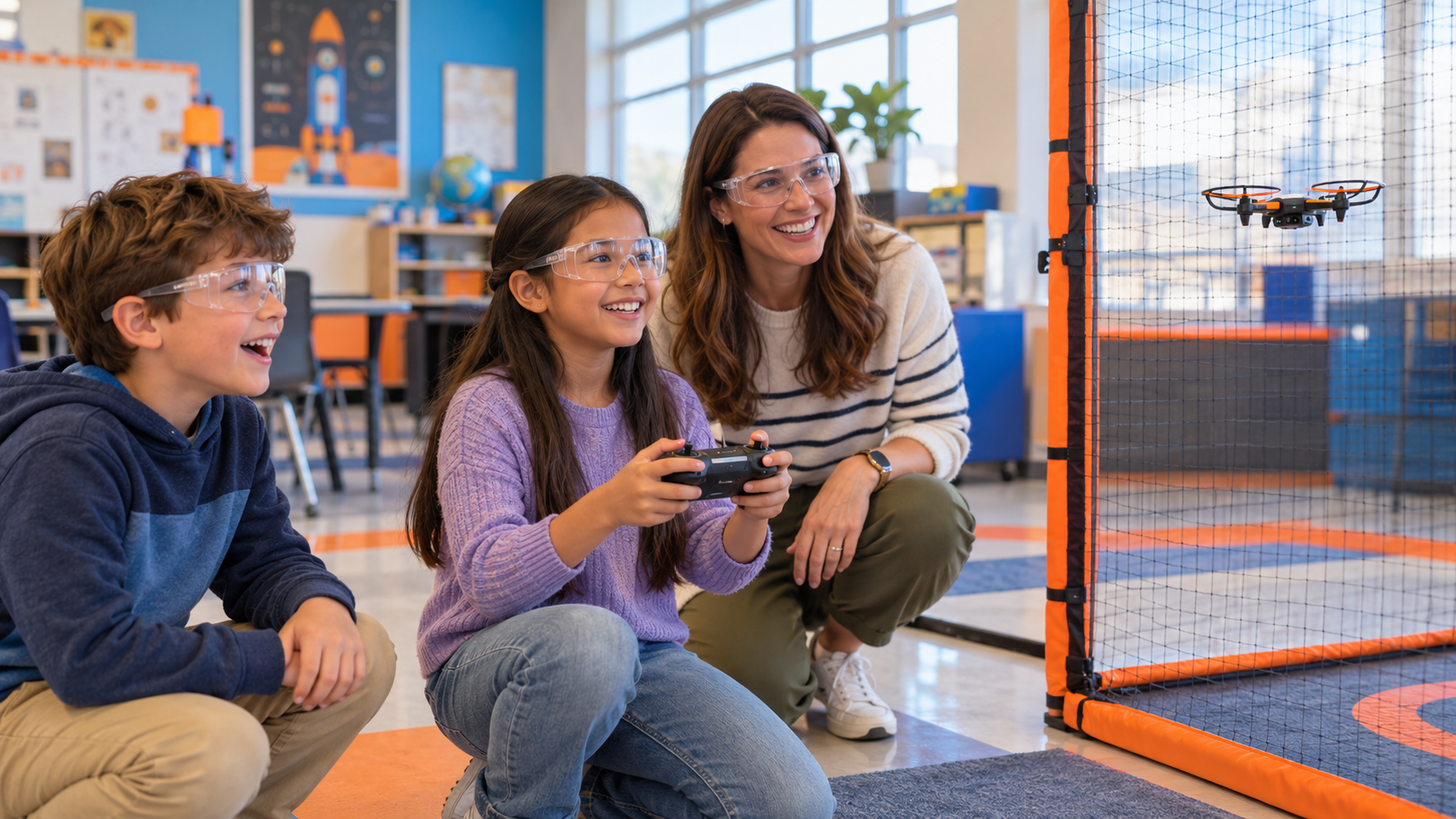
The Rover Classroom Drone Kit is the hands-on entry point for students in grades 3 to 5. It includes classroom drones, controllers, safety gear, and a mini inflatable obstacle course.
Students start with basic flight challenges, like box flights, altitude control, and slalom courses, before moving on to full games. They fly on the same controller they will use later in the drone racing program, so the skills they build carry forward.
Gamified Learning
Students play basic flight games built for this age group. They practice steady hands, spatial judgment, and quick decisions, skills that carry over into any hands-on career. Teachers can add rewards, badges, and leaderboards to spark competition among young students.
Smart Classroom Tools
Teachers get smart classroom tools, such as battery chargers, labeled drone cases, and a fireproof storage bag. We also provide videos and one-on-one virtual training for their first lessons, so a classroom teacher with zero drone background can run the program from day one.
Curriculum That Fits Your Existing Programs
Our drone curriculum is built to fit into your existing elementary programs for grades 3 to 5. It covers drone basics, how drones fly, and early career awareness lessons like “Careers in Uncrewed Systems.” Instructor training is also built into it, so your teachers can integrate it easily into classroom lessons.
Start Career Exploration Early So Your Students Are Ready When It Counts
Most career resources for this age group ask students to imagine a job they’ve never seen up close. Flying a drone gives them something to visualize. They practice steady hands, follow a flight path, and hit a target. Along the way, they start to see themselves as capable with technology.
That early confidence matters more than any single lesson. A student who develops early STEM interest is more likely to pursue it seriously by high school. The goal at this stage is to build the foundation that makes every later stage possible.
Contact us to learn how Rocket Drones helps elementary students explore careers with drones through gamified activities and interactive modules.
Frequently Asked Questions
What age should career exploration start?
Do elementary teachers need drone experience to run this kind of program?
How does drone-based STEM learning connect to career exploration standards like ASCA?
What do career exploration activities look like for elementary students?
Do elementary students need any background knowledge to take part in these activities?
Drone
Competition
2027
Aerial Perspectives Podcast

Discover the exciting world of drones with Aerial Perspectives! Each episode takes you behind the scenes with drone pilots from diverse industries–cinematography, construction, inspection, agriculture, and more.