How Drones Are Used in Construction (And Why It’s Becoming a Must-Know Career Skill)
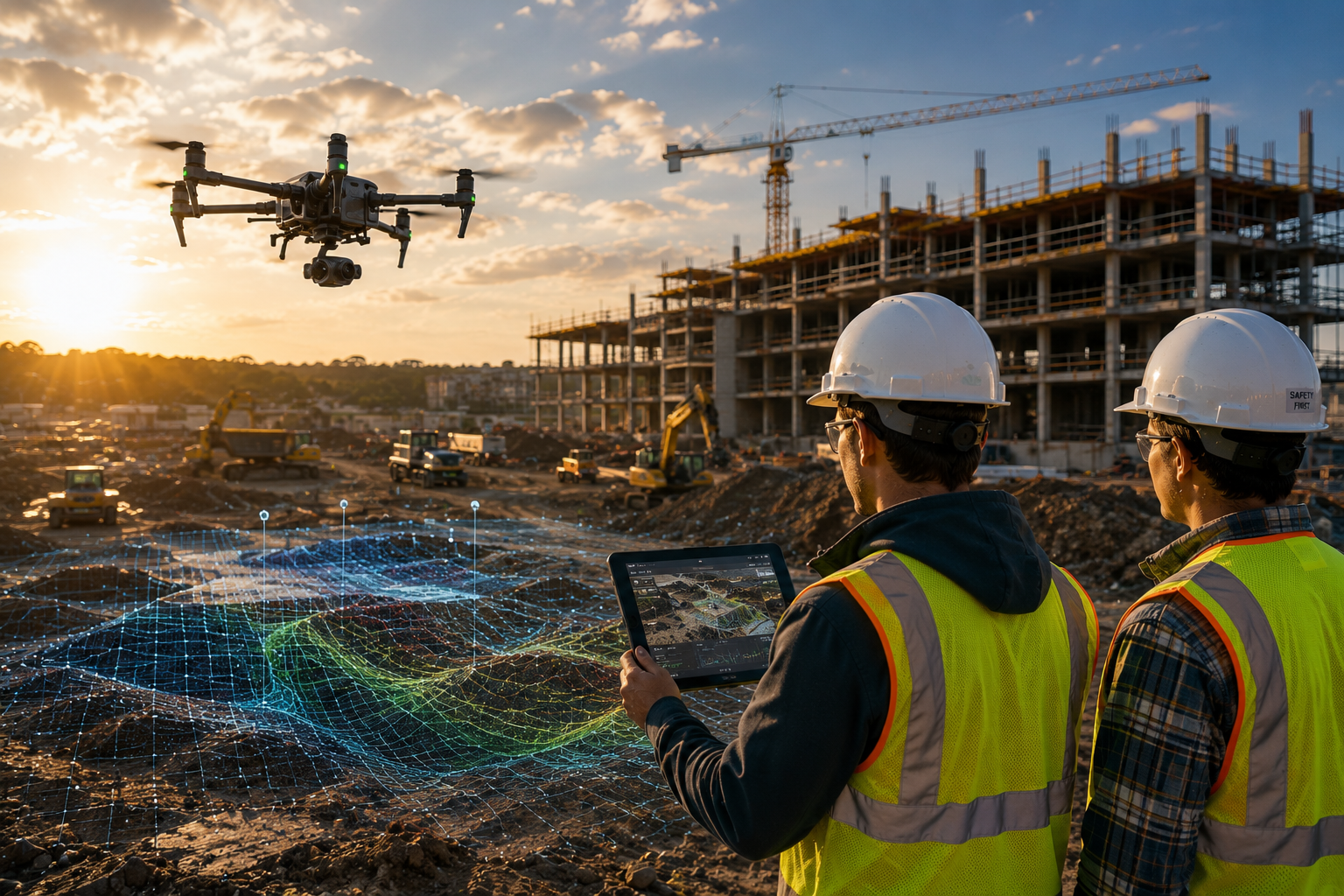
Construction is the largest industry for drone adoption globally, and is projected to reach $83.0 billion by 2035. Companies are using drones to survey sites, monitor progress, inspect structures, and manage materials.
The work that used to take teams of specialists days to complete now happens in a single flight. Drones in construction have moved from a novelty to a daily operational tool.
But the drone doesn’t run itself. Behind every useful data output is an operator who knows how to plan the mission, execute the flight, and deliver something a project manager can act on. That skill set is specific. And right now, not enough people have it.
This article covers how drones are used on construction sites, what employers look for when hiring operators, and why this is a strong career pathway for students.
Key Takeaways
- Drone competency is becoming an important skill set for surveying, progress monitoring, inspections, stockpile measurement, and safety documentation.
- FAA Part 107 is the legal baseline for commercial drone work in the U.S., but a certification is not enough.
- Construction employers want drone operators with hands-on skills in mapping, inspections, data collection, and jobsite safety.
- Rocket Drones prepares students from grades 3 through 12 with certifications, hands-on training, and real-world mission experience that construction companies look for.
What Construction Companies Are Using Drones For
Before drones, surveyors walked sites on foot, workers climbed structures to inspect them, and project managers collected data by hand. A single flight now covers surveys, inspections, and site documentation that used to take days.
Site Surveying and Mapping
Teams need accurate topographic data to map elevations, slopes, drainage patterns, and utility lines. A drone equipped with a high-resolution camera or LiDAR sensor captures all of this in a single flight.
These images are processed via photogrammetry software to produce 3D terrain models that show every slope, dip, and surface feature. Engineers can use that model to plan foundation design, earthwork estimates, and excavation.
Progress Monitoring
Project managers use drone footage to track which sections are on schedule and which are falling behind. Because every flight is time-stamped, that same footage doubles as evidence when disputes come up around delays or installation errors.
Structural Inspections
Drones provide aerial surveys that run faster than ground-based methods and reduce total inspection costs. They can access facades, rooftops, and hard-to-reach areas mid-construction. Teams use these aerial photographs to document site conditions and update stakeholders with current visuals.
Stockpile Measurement
Construction companies need to know exactly how much material is on site at any given time to avoid overstocking or understocking.
A drone can fly over the stockpile and capture hundreds of overlapping images from every angle. Teams can use software to stitch those images and calculate the exact volume of material available on the ground.
Safety Monitoring
Traditional safety checks mean a supervisor needs to inspect heavy machinery, unstable ground, and elevated structures on-site. Drones cover the entire site to spot unsecured materials, workers without protective equipment, and unstable conditions.
Why Drones in Construction Are a Must-Know Career Skill
Construction teams are using drones for their daily operations to save time, improve safety, and document sites in real-time. But they don’t have enough workforce to operate these drones.
Companies need operators who can handle inspections, mapping, progress tracking, and technology integration on jobsites. A candidate who understands both drone operations and construction workflows has an advantage over those without these job skills.
That combination of hands-on work, technology, and problem-solving is rare, yet an important career skill set in construction.
Qualifications Needed to Become A Construction Drone Operator
FAA (Federal Aviation Administration) Part 107 is the drone certification that authorizes drone operations in the United States. But it’s only a starting point for commercial drone work. As drones in construction become standard, employers look beyond the certificate to hands-on field experience.
According to the FAA, the number of remote pilot certifications is expected to reach 472,269 by 2028. More certified pilots entering the market means the baseline credential becomes less of a differentiator. But someone with hands-on experience in real construction scenarios can stand out from other candidates.
Here are some skill sets construction employers look for in a drone operator:
- Manual Flight Proficiency: Fly drones without GPS or automated sensors in interference, tight spaces, and unpredictable conditions.
- Airspace Knowledge: Apply FAA regulations, flight restrictions, and airspace classifications to real operational decisions on active job sites.
- Data Collection: Capture aerial imagery and produce accurate maps, inspection reports, and site documentation.
- Mission Planning: Read site conditions, plan the flight path, and execute before the drone leaves the ground.
- Jobsite Safety: Operate within OSHA, EPA, and NFPA frameworks. Flights and data carry legal and safety consequences.
- Communication and Problem-Solving: Translate data into reports that project managers can act on. Diagnose bad data, adapt to changing conditions, and deliver under deadlines.
How Rocket Drones Helps Students Develop Drone Skills for Construction
Rocket Drones is a drone education company that offers curriculum, skill-set development, instructor training, and certifications. We help schools integrate drone technology into CTE, STEM, and other classroom programs for grades 3 through 12.
Our program provides foundational skills used in drone operations, including precision flight, aerial imaging, inspections, and mapping concepts, with hands-on skill development and real-world scenarios.
FAA Part 107 Certification Training
We provide FAA Part 107 certification training for students aged 16 and older. Students learn airspace classifications, flight regulations, and safety procedures; the same knowledge base that construction employers verify before hiring.
Age-Appropriate Curriculum
Our drone curriculum runs from grades 3 through 12. Younger students start with foundational flight concepts and basic drone operations. Older students advance into inspections, mapping, and career pathway training. Every stage builds the technical foundation students need to apply drone skills directly to construction workflows.
Gamified Learning
We use flight challenges, team competitions, and interactive quizzes to teach drone concepts. Scenario-based challenges train students to read conditions, adjust quickly, and execute with a clear objective.
Practical Application and Skill-Building
We build hands-on flight training into the program from the start. Students can log real flight hours and build a video portfolio throughout the program.
Prepare Your Students for the Modern Construction Workforce
As construction companies integrate drones into daily operations, the demand for trained operators will keep growing. Students who have practical drone skills, such as aerial imaging, site monitoring, data collection, and mission execution, can enter the workforce and stand out among their peers.
We help students from grades 3 to 12 develop hands-on drone skills with a documented portfolio. We offer curriculum, real flight hours, and scenario-based training, integrated into your existing classroom structure.
Contact us to learn how we prepare students with the drone skills construction companies are actively hiring for.
Frequently Asked Questions
What types of drones are used on construction sites?
What construction jobs need drone operators?
Do students need prior construction experience to pursue this career?
How do drones measure material stockpiles on a jobsite?
Is an FAA Part 107 certificate enough to get hired in construction?
Nationals 2026
is around the corner.
Aerial Perspectives Podcast

Discover the exciting world of drones with Aerial Perspectives! Each episode takes you behind the scenes with drone pilots from diverse industries–cinematography, construction, inspection, agriculture, and more.


