Student Drone Team Spotlight
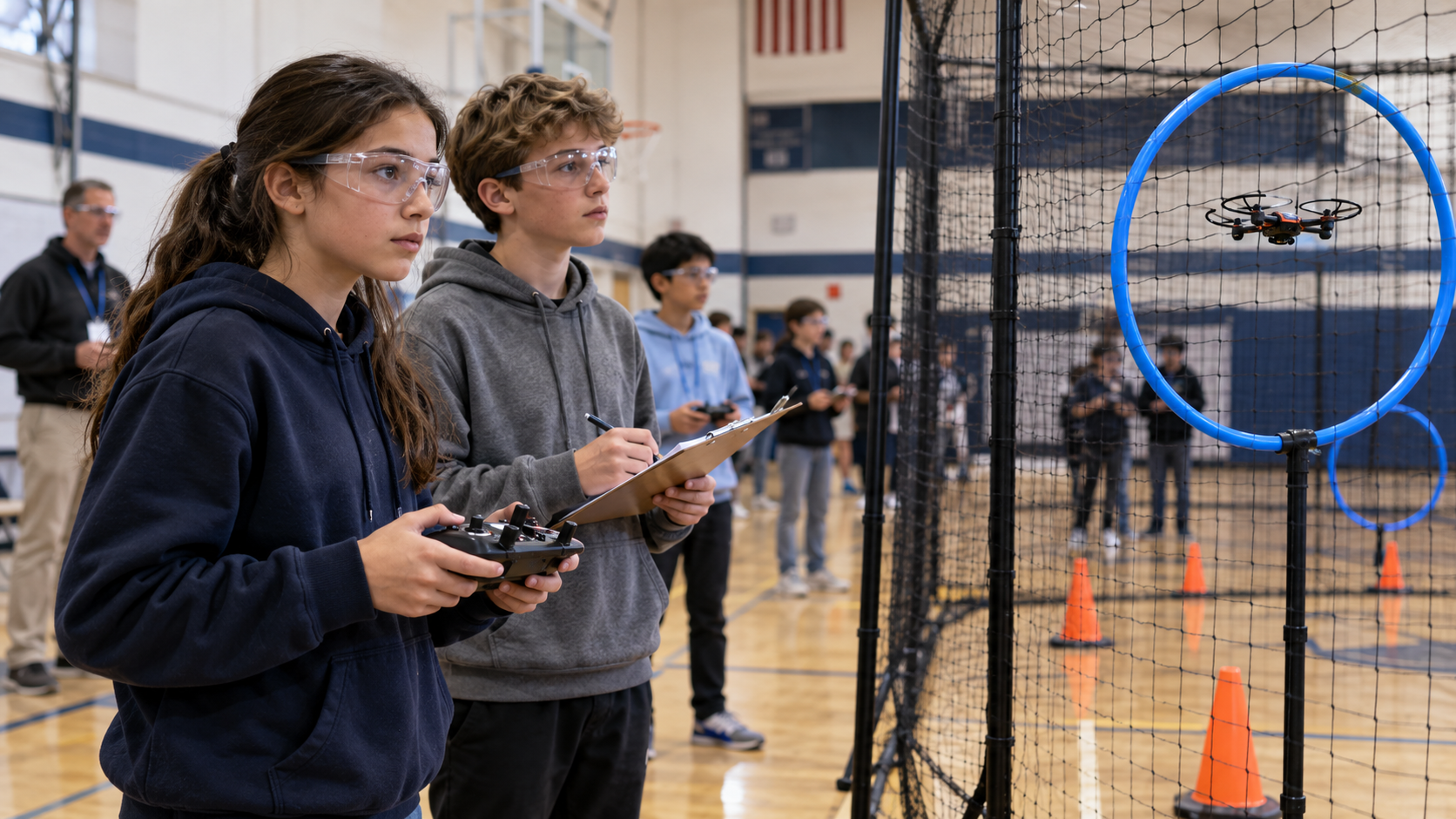
The Audi Aero Cats at Owen D Young High School in New York’s Mohawk region offer a clear view of what a student drone team can become when flight practice, engineering work, and classroom structure work together. As the first drone racing team in the region, the team gives educators a real example of how a school-based drone program operates in practice. This video is built around student voices from Sam, Kyra, Michael, and Tanner, with guidance from science teacher Mr. Jeff Rubin, who advises the program within Owen D Young School District. Their comments show how a school drone club can move beyond occasional flight sessions and become a steady progression toward career-ready skill building.
Skills that build beyond flight time
The students describe a program that develops more than controller confidence. Sam and Kyra point to simulator use as a way to build control and focus before live flight, showing how a drone simulator for students supports safer repetition and stronger manual piloting habits. Michael explains that broken propellers, cracked frames, and troubleshooting tasks become part of the learning process, turning in-class repair into practical engineering instruction. Students also connect the work to fine motor skill development, problem-solving confidence, and social outcomes such as making new friends, which gives this student drone team the feel of a working technical environment rather than a hobby group.
The career pipeline forming in a school drone club
The career signals in this spotlight are direct and specific. Students connect drone experience to agriculture, especially precision spot-spraying that can reduce pesticide use and target problem areas more efficiently than broad field treatment. Tanner also names drone racing as a career goal, while the narration points to broader drone technology pathways that begin with school-based skill development. In that context, the Audi Aero Cats show how a school drone club can serve as the front end of a larger CTE drone program, where classroom drone curriculum, flight progression, and employer-valued technical skills help students see a pathway into commercial drone work and future FAA Part 107 preparation.
Advice from students who have done it
One of the most useful parts of the video comes from the students’ own guidance to new programs. Tanner advises schools to start slower than they might expect, giving students time to build comfort before pushing speed or complexity. Sam and Kyra describe the next steps as a progression: first basic control, then back-and-forth movement, then circles, then laps through classrooms or hallway racing as confidence grows. That sequence matters for educators because it reflects a scaffolded model that supports skill retention, safer manual piloting, and stronger long-term outcomes, and it aligns with how Rocket Drones structures classroom drone curriculum and race kit progression.
The Audi Aero Cats provide a credible proof point for what a well-structured drone learning environment can produce. Their experience shows that students can build technical ability, social confidence, and career direction when flight practice is paired with repair work and a clear pathway. For schools exploring their own student drone teams, Rocket Drones provides the broader program structure that helps educators turn early interest into a lasting CTE pathway. The team at Owen D Young High School shows what that progression can look like in practice.
-
Simulator practice and drone repair build skills students can name
The students describe skill growth in concrete terms, not vague enthusiasm. Simulator sessions help build control and focus before live flying begins, while in-class repair tasks such as replacing propellers and fixing cracked frames teach engineering fundamentals through repeated problem-solving. That combination gives students real language for what they are learning and shows educators how manual piloting and technical repair can develop together inside one structured program.
-
Students connect drone education to real career pathways early
This spotlight shows students identifying specific outcomes, not just enjoying an activity. They talk about agricultural spot-spraying as a more efficient field application, and Tanner names drone racing as a possible career direction. Those examples matter because they show how a classroom program can move students toward employer-valued fields and support a larger pathway into drone technology, commercial operations, and later FAA Part 107 preparation.
-
The progression starts slow and builds confidence before speed
The strongest program advice in the video comes from students who have lived the progression themselves. They recommend beginning with slower, controlled flight practice and waiting until students are comfortable before adding circles, laps, hallway flying, or racing conditions. That pacing helps students build confidence without skipping fundamentals, and it gives educators a repeatable model for launching a student drone team with better long-term results.
Frequently Asked Questions
What is a student drone team?
What skills do students learn on a student drone team?
How does a school drone club connect to commercial drone careers?
How does a drone simulator for students help build flight skills?
What advice do experienced student drone team members give to new programs?
[00:00:00] Narrator: Owen D. Young science teacher Mr. Jeff Rubin has incorporated drone technology into his classes and is serving as an adviser for the district's new drone club. The club is the first drone racing team in the Mohawk region, and they compete as the ODY Aero Cats.
[00:00:18] Sam and Kyra: One way of improving my skills is by using a simulator to help me control and focus just on the drone.
[00:00:28] Michael: Things I've learned about engineering and technology from drone racing — like how you can fix the propellers if they get broken, or how to fix the drone if part of it gets cracked.
[00:00:42] Sam and Kyra: I've been working — it's helped me with my fine motor skills. All the things that have impacted me, like making new friends. I do see myself relating drones to technology and agriculture, with spraying the fields and fertilizing them. In agriculture, the machinery driving through compacts the soil and hits spots that don't have weeds with spray, so it's wasting money. With a drone, you can just spot-spray some areas and it'd be much more efficient.
[00:01:21] Tanner: My advice to schools starting drone programs is to have the kids start out a lot slower than they normally would, and then progress a lot faster from there.
[00:01:34] Sam and Kyra: Once you get a little more comfortable with that, start going back and forth in some areas, do some circles, and then start doing laps around classrooms or racing up and down hallways.
[00:01:47] Tanner: My future aspirations in racing drones are to get better at racing, and I want to take on a career in racing drones.
[00:02:00] Narrator: The hands-on learning with these drones is giving students experience with technology, troubleshooting, problem-solving, and making hands-on repairs — and inspiring some of the students to pursue careers in drone technology, including the agricultural applications that could reduce the amount of pesticide use on local crops.
Our Latest Videos

What's New in our Blog