Episode 5: Aerial Perspectives - Law Enforcement Drones & Government Contract Flying
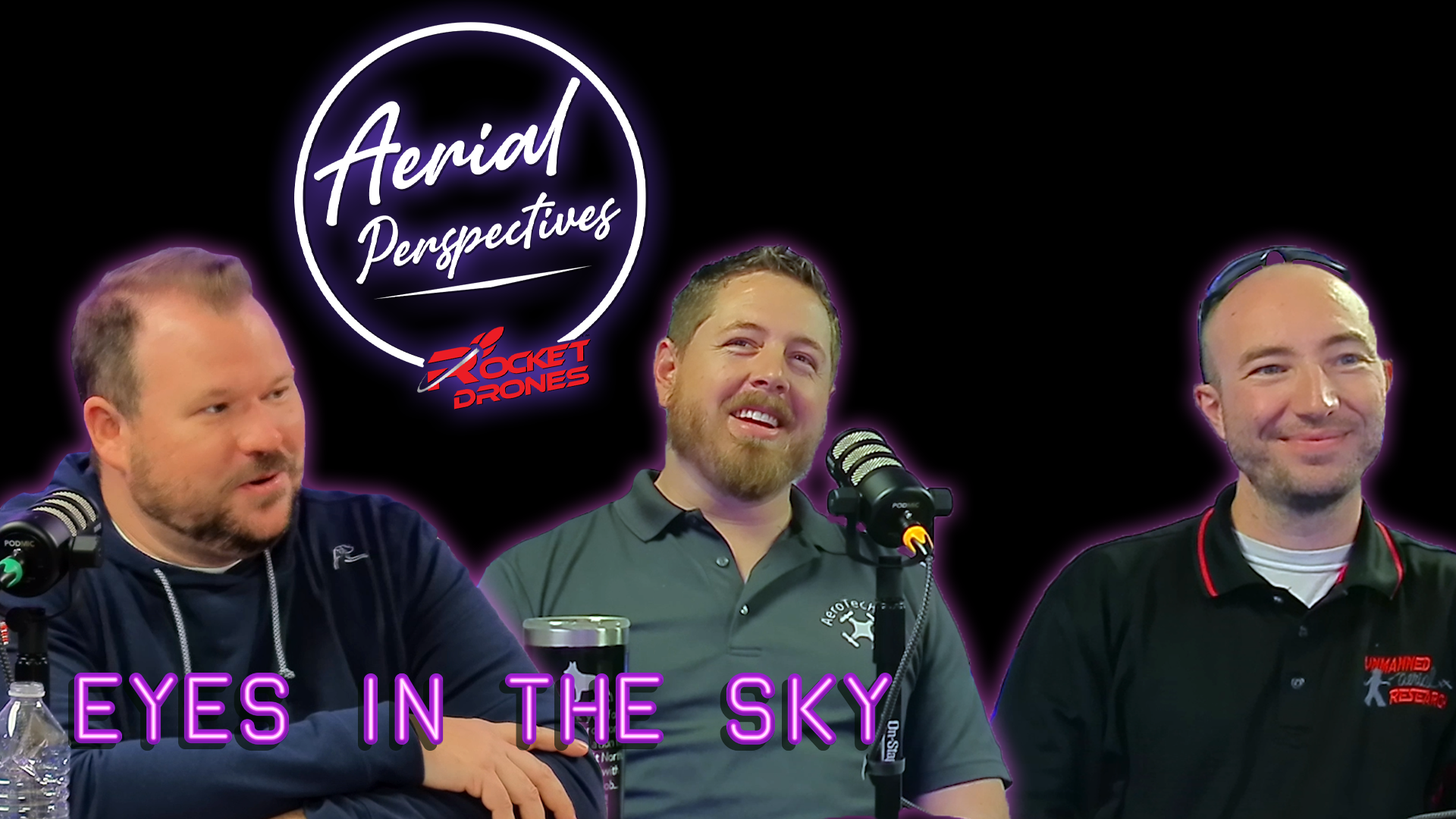
Guests: Mario Worth (CEO, CRASH Robotics & STEM Hub) & Richard Drain (Owner, Aerotek Drone Services)
Host: Chris Tonn
Location: Rocket Drones Studio, Florida Panhandle
---
00:00:00 Chris Tonn: All right, all right. Welcome back to another episode of Aerial Perspectives. Here today in the Rocket Drones Studio, we're excited to have our first podcast with two guests. We're very fortunate to have a little bit of a law enforcement background in this one, which is a very cool opportunity zone from the drone side of things.
I'll kick it off here with a quick little intro for our guests, Mario and Richard. So today we're excited to welcome two incredible guests to the show: Mario Worth, CEO of CRASH—Crestview Robotics and STEM Hub—and Richard Drain, owner of Aerotek Drone Services.
Mario's drone journey began as a kid flying RC and professionally took off in 2014. With expertise in nearly every aspect of drone work, he now specializes in Class 3 fixed-wing operations on government contracts. He's proud of accomplishments like leading the first successful law enforcement UAS operation in the Florida Panhandle, building a heavy-lift multicopter capable of lifting 800 pounds, and founding CRASH Crestview.
Richard, meanwhile, started working with drones two years ago as an operator for the Florida Highway Patrol, where he contributed to vital missions including tracking criminals and recovering lost individuals. Now as the owner of Aerotek Drone Services, he specializes in aerial photography and videography.
Both guests bring incredible expertise and shared passion for innovation, guided by philosophies like Mario's "Don't be afraid to try it out and learn from your failures" and Richard's "In life, you have to be flexible so you don't get bent out of shape."
We're diving into their unique journeys and the impact drones have on careers and communities. So with that, welcome guys, and thanks again for coming out for the show.
00:01:45 Mario Worth: Thanks for having us.
00:01:47 Chris Tonn: Absolutely. So I always like to start with kind of the beginning chapters here. For those that don't know, this is a wonderful day in the life of a drone pilot from different walks of industry. And in particular, we've got a little bit of new and a little bit of old to the picture of the drone space. So Mario, I'll kick it off with you. One of the fun things is just—how did you get involved with drones and how did it land into a line of work?
00:02:11 Mario Worth: So my background is also flying helicopters. I was flying out of a little pad in Nevada and also up in South Dakota. Up in South Dakota, we did some helicopter filming, did some commercial shoots and all that. We did also some wildlife counts and all the stuff that you see that are now just normal for drones and not so much helicopters anymore, right?
But back in those days, drones weren't that popular. They were all manual flight. You would put a GoPro on them or something similar to that, and you'd just guess if you got the footage or not. So I saw the shift in the industry in the helicopter side from the actual physical helicopter to the drones, and I jumped on the bandwagon way too early, I believe, because I spent more of my time explaining what a drone is than actually flying.
So I realized that very quickly, but it did help me kind of be there for the beginning of the whole drone era, right? When the FAA was trying to figure out how do we accept these into the NAS, because we have no regulations written except the hobby rules. So now we have all these guys coming in commercial-wise. And you know, first they held the chain a lot tighter than what it is now. It's been released a little bit, but that's kind of how I got into it—I saw the loss of business from helicopters shifting over to the drones.
00:03:46 Chris Tonn: Makes sense. Now you're holding back a little bit. This wasn't any just regular helicopter that you were getting to have the experience to fly. I've seen it on TV a few times back in the old days. What was that helicopter?
00:03:59 Mario Worth: Yeah, so my specialty was in the old MASH helicopter, a Bell 47. I've flown almost every model of that except BJ and Soloy. So those are the last three that are on my bucket list that I'm gonna need to fly. And then I've flown every model, and that's about as far away from technology as you can get.
Literally, the old D models have a kick starter on the floor—like you have a little pedal that you hit on your foot and it starts the engine. So it's pretty much as far away from technology as you can get to then jumping onto drones, which is as much cutting edge as it gets. So two opposite spectrums, right?
00:04:42 Chris Tonn: The full glass canopy cockpit and the original FPV view, man. Back in the day. Well, very cool. And then Richard, of course, we've got a newer chapter of getting into the drone space, but you've still got a couple years under the belt. How did it kind of get into the work world, and how did you first get involved with drones?
00:05:01 Richard Drain: So my dad's always worked in aviation, and I grew up out at the airfields with him doing the RC planes. And so I always had kind of an interest in drones and planes and RC helicopters and things like that. And several years go by, and there was an opportunity to come up whenever I was working for FHP to get involved with the drone team there, to be able to do things like search and rescue, looking for people that run from different law enforcement agencies, and things like that.
So I knew that it was a developing industry, and I knew that it was a one-time opportunity. It was either take it now or leave it on the table. So I decided to go for it. And my little bit of knowledge about the different aerospace regulations and whatnot that I learned from my dad, I just used that and applied towards the application for the position. Fortunately, I was selected and kind of fell into it about two years ago.
00:06:02 Chris Tonn: That's so cool. I love to hear that. It sounds like everybody starts with some of these consumer products, whether it be RC planes, RC helicopters, or even the smaller drones. And it just opens the imagination to where the path can point from there. So we're in our beginning chapters of getting into drone careers. What was kind of the first job opportunity that you really connected with on the drone path? And then catch us up also to where you are now.
00:06:35 Mario Worth: Yeah, so the first path, honestly, was real estate, and it was a tough one to get into because back then they just take pictures with the DSLR and that was it. And so you're trying to break into that industry and they don't want you. They don't want to spend that extra money because they're out there on commissions, and they're gonna have to fork it out beforehand and hope that they get that sale for that return. And nobody was doing it back then, so why would they jump onto it?
So like I said, it was a lot of education, a lot of realtor breakfasts. And then I was in a networking group and got together with this realtor, and I'm like, "Look, tell you what. I know you won't hire me for these $200,000 houses, $100,000 houses you're selling. How about we do this? You just hire me on any house, and I'll do it for $100 every house, just to get it kicked off."
And I mean, in the end, I was losing money. But I needed to start somewhere. And he agreed with it. And that's really how it started in this area, like in the Crestview area, because Crestview doesn't have some of the high-end houses that you would see in Pensacola, Destin, and everything. So he used me on every single house—$100, right?
And all of a sudden, those realtors in the area saw like, "Well, now I need to advertise because he has a competitive advantage, because now he's getting clients and listings because he's offering that service." So it became a competitive realm there. Of course, only he got the sweetheart deal. The next clients that were coming, I actually needed to make some money.
So that's how it got to that point. With that, I started modifying the old DJIs. I built an NDVI camera. I tried my luck at some of the farm stuff, which is a difficult industry in itself because farmers—they don't want to know if they have problems in the field. A lot of times they just don't. And that's across the board. So if you come with a solution for them to know the problems in the field, they're going to shut you down right away.
And that kind of was like, well, we're doing mapping. So now let's go from the farm fields maybe into some of the mapping for progress reporting. And keep in mind, back then, I still had to do a lot of calculations. I had an iPad and I had my DJI and had to draw out my little lawnmower pattern on my iPad and then zoom out to a particular zoom and set it on like 10-second intervals or something, and just fly and have my constant speed. So it was manual—collecting those mapping points and then stitching them together because there was nothing out there back then. It worked. It wasn't the greatest, but it worked.
And then that kind of forced me to build some custom equipment, and I didn't have really an engineering background or how to build the damn things. So I just went and bought some stuff and put them together, and ended up it's working magically. I still don't know how, but that's kind of brought me into building and constructing the things.
And then Pixhawk came out with the Mission Planners. So that was kind of a shortcut for me building. And that got me that experience, which led me all the way to a friend of mine that builds the Osprey drones—Unmanned Aerial Research. And he hit me up and was like, "Hey, I really could use somebody to help me. He's been building them the entire time, he's been flying them, but he hasn't had really a lot of experience with that mission planner and that ground control station and calibration and everything."
So he asked me to come on board and kind of help him out with some of that. So I jumped right away on board and don't regret it. So now we're flying missions for the government on test flights where they're testing out new sensors, new equipment, flying in GPS-denied environments. That kind of stuff. And we take those Osprey drones, fly them up to 8,000 feet AGL, and send them 8K out—and hope they come back.
So we can realize when something is wrong and bring it back in time and hope that all the autonomy works that they're pushing onto our aircraft while we have control over the aircraft. So yeah, that's a definitely nerve-wracking and fun job, especially when you have a couple—like half a million dollar payload underneath that is now in your custody and control.
00:11:30 Chris Tonn: That's—yeah. No pressure, huh?
00:11:32 Mario Worth: No pressure at all.
00:11:35 Chris Tonn: Well, it's neat that you painted that pathway a little bit too of starting out teaching yourself about some of these systems and then becoming a little bit known in the area that this is a capability that you have. And obviously as the market grew, we now have more and more of these backyard—well, we're fortunate enough to be in very military, high-test environment here at Eglin Air Force Base and surrounding fields.
But it sounds like there was a knowledge that, "Hey, Mario's got some experience here. We need to bring him over." And from Richard's side, the difference here is Wild Wild West of learning, education, and protocols—and hopefully it sounds like Richard, you're kind of coming into this world of the Osprey drones as well, but it sounds like you may not go down the same crash course as Mario. Is there a little bit that y'all can share of the training that might be different from when you started to where we are now?
00:12:32 Richard Drain: Absolutely. First thing I'll touch on—you definitely have to have some faith. You have to have faith that these pieces of equipment are going to do what you want them to do and actually come back. And kind of as Mario mentioned earlier, they do rely at certain points on GPS and things. And during some of the search and rescue missions that we did, there was times where we did drop down below those tree canopies and you lose that signal, and you have to be able to remotely operate it yourself and trust your skills and put those to the test and come out of those situations—and not just rely on the technology.
So I mean, there's still a level of do-it-yourself there, and then there's also a level of relying on the equipment, the GPS and things like that. But overall, yes, I did come in whenever all this has already developed. I didn't go through the Wild Wild West moments of doing it completely by myself. So I was kind of fortunate in that sense. I haven't quite got the experience on the building side of things. I'm just more so seeing the practicality side of things with actually operating them and putting them to use.
00:13:42 Chris Tonn: That's awesome. And so cool that we have some of these resources again right here in the Panhandle of Florida. But I do want to—well, one—I want to let the audience know too that Mario's holding back on some really cool other projects for sure. And in addition, he was a critical part in the launch of Pelican Drones back in the beginning chapters.
Ten years ago there was no Part 107 license where you could just go out and do the drone commercially without jumping through hoops. There was a Section 333 exemption and the requirement to have a sport pilot license or higher on site. So Mario was essentially a piece of essential compliance on all of our drone sites and taught me so much about the airspace that is very dynamic in this area.
But I want to hear a little bit more about law enforcement. Obviously, this is a really cool area to see utilization of the technology that helps efficiencies—we don't always have the budget for helicopters to go up for searches and other things. I'm sure it's great for situational awareness and so on and so forth. But give us a day in the life of law enforcement scenarios that might be of interest to our audience, Richard.
00:14:58 Richard Drain: We used them for so many different things. Again, one of the things I already mentioned is finding people that ran—search and recovery. But there's so much more than just that. We use them for rebuilding crash scenes. Especially on Highway Patrol side, Highway Patrol is known for working traffic crashes. Whenever they had fatalities, we were able to go out with the drones and use the drones to actually map the scene, and then go back and use Pix4D software to actually put everything together and build 3D models.
And then we had the search and rescue. We had the—unfortunately at times—body recoveries in different situations. Although sad, it's a very useful tool to be able to help bring peace to a family, to be able to pull a body back in. Finding elderly people that wander off that have Alzheimer's or dementia, or kids with autism and things like that.
But yeah, various different uses. Even just to be able to get an idea of what kind of damage has been done after a hurricane. Or again, going back to the search and rescue, flying through half-collapsed buildings instead of sending people in, putting them in danger. Instead, we can use the drones and actually fly into buildings and look for people and try to coordinate a rescue.
00:16:25 Chris Tonn: So that's so cool. And I'm sure it's just a good looky-loo in a traffic situation, or a million other things that come handy for just situational awareness in this space. Now Mario, I know you kind of brought a drone program to the Crestview Police Department. Tell a little bit about how that went and what that was like. Again, Wild Wild West. Here we go.
00:16:50 Mario Worth: Yeah, I mean, it was—there was no standardized training. There was no real curriculums out there or anything. So we just put the guys on the sticks and put them through the ringer. We applied for Section 333 back then and for exemptions. And it was difficult to make work because it wasn't even in the budget.
So basically they sent me to the academy and said the only way—we can't subcontract the company, but we can hire an additional officer. So that's how I kind of worked the deal out. So they sent me to the academy, went through that, came in as an officer, which caused some tensions in law enforcement. Law enforcement is kind of a hierarchy that you get. And then I have a commander that's in charge of the new drone program, and he doesn't know anything about it. And so I'm advising him, but I'm just an officer down the line when you have all the other sergeants. But then I get called off the road for hours and sit in the commander's office. And so the other guys are like, "Is he an officer? What's going on?" So there's a lot of tension there. And we dealt with that a lot as well.
00:18:09 Richard Drain: The drone program for FHP is fairly new. They had it a few years before I got into it. And not to interrupt, but just to speak on that a little bit—they had it a few years before I actually got on the team. However, there was a handful of officers across the state that were certified. So they were so widespread, you couldn't have one officer over in Tallahassee be able to make it over to Pensacola or over to Crestview and Destin to do a mission like that.
So we needed to expand and grow across the state. Have people staggered throughout the state so that way we could respond quicker. The problem was, as Mario mentioned, nobody over here was used to that. And so even whenever I got on, I was myself as well as a couple of other officers that we all got on at the same time—we were the first drone pilots for FHP in Troop A, which covers all the way over from Pensacola to the other side of Panama City. But we were the first ones. So all of our command staff, they didn't know how to utilize it. And they're still learning that now even since I've left law enforcement.
But we had to explain to them how this is useful, how we can use this for crash scenarios, for when people ran—and they weren't thinking about it. And education is such a big part of that. And we had to do a lot of it. We did more education, I think, like Mario said, than actual flying.
The tactics too—like people don't think about the tactics that you have to employ. So give you an example. Unfortunately, the drone did not pick him up. That was one of my first missions that wasn't successful, unfortunately, but it was a huge lesson learned. So somebody escaped from the jail, right? So they called me out. I came out, threw over my vest, and pulled out the drone and I was flying.
And I always said like, "I need somebody to be with me, because when I'm flying, my head is down. I'm looking at the screen. I'm not situationally aware. So if the guy comes out behind me, I'm screwed." So I'm down there and I tell him, "Hey, I need somebody there. You've got enough people that are just sitting around on the radio kind of directing people. I need that person next to me."
And so I'm down there flying. Next thing I look up, there's nobody around me. And now we've got civilians approaching and asking me like, "Hey man, what you doing?" And I'm like, "I'm trying to focus on flying the drone, trying to find an escapee." And I have nobody around me to kind of block me.
So it comes to tactics the same way as when they started deploying the K-9. They deployed the K-9. I'm following the K-9, just to make sure that the K-9 is okay and doesn't get ambushed. And next thing I know, the K-9 stops and looks up—he's looking at that drone. He's now distracted from the track. So guess what? The K-9 handler was pissed, because now I just ruined that K-9's track with the drone.
And that's kind of one of those realizations when we started this—that I didn't have any experience in law enforcement, really. Fresh out of the academy. Complete rookie. But I've got that drone experience. And even with that drone experience, when you—you don't think about that K-9 picking up the drone. You should, but you don't.
And so then it comes out where you have to start developing these tactics and strategies. And that's where that conflict comes back in because you're in the commander's office and you're saying like, "Hey, we need eight training days with the K-9 where they're running a track and I'm flying the drone over the K-9."
00:22:15 Mario Worth: Not only do you need to coordinate those trainings with the K-9, but also your QRF team, which is the riot control team. So if you deploy to a riot, they understand that you can see way more than they can. So we need to be on the back lines, being able to relay that information and give them real-time data, as well as the SWAT teams to be able to train with them. There's a lot more that goes into it than picking up the sticks and just flying.
00:22:45 Richard Drain: I had a situation kind of like what he mentioned where somebody actually did pop out behind me. I spent quite a few months over in Texas at the southern border assisting over there. FHP had about 100-110 troopers over there around the clock.
00:23:03 Chris Tonn: I remember that, yeah. DeSantis sent them over there. That's great.
00:23:07 Richard Drain: We had SRT units, we had drone pilots—a broad scope all the way down to the patrol trooper. The patrol guys, they would sit at one kind of stationary place and watch an easy spot of the border. But every once in a while they do get crossings. They put us drone guys out around the areas where we had the smugglers and the higher risk people.
And there was one particular day we were actually over there, and we were tracking this one group. I had eyes on them with the drone, and I dispatched our little team to go apprehend this group of migrants. And we had a couple of drone pilots there. We were all busy doing different things. One guy was recharging batteries, setting up stuff for his flight. One other person was flying as well. We were at different altitudes.
And so we're focused. Like I said, you're looking down at your drone. You got to make sure you're not going to crash into something. And lo and behold, this group of three migrants walks out right behind me. And again, we're in a high-risk, high-traffic, weapons, human trafficking kind of area. And they could have walked right up behind us and probably taken us out.
So on the law enforcement side, you have to have somebody there with you. But really, any kind of form of drone work, you need to have somebody there with you. And so that provides its difficulties, like you said, with getting somebody set up, especially teaching your command staff that we need that extra body. That also calls for extra funding, extra money, resources.
00:24:48 Chris Tonn: That's so true. And it's funny—y'all actually took my next question right on out of there, which was, what does a spicy day at work look like? And it sounds like that was nice and spicy, to say the least.
Fast forward to today and the smaller chapters of where we started with a few police forces with these drones—in particular the Panhandle—it sounds like y'all kind of led the way for the state. Was Miami or were they doing it?
00:25:19 Mario Worth: There was other ones in like lower Florida that had a bigger budget. Sure. Little Crestview, right? But I can tell you, it was definitely an eye-opener, especially for the Panhandle being so much military. There's a lot of cooperation that you're going to have to do with the military. Your FAA approvals and everything. So that's really what gave the edge—was my knowledge in that aviation.
Give you an example too. I had one of my competitors report me to the FAA back in the days. And that's where that knowledge comes in. And I think that's the only reason why I was able to help that Crestview PD out and get it started and lead the way in that area was because of that knowledge, because they wouldn't have gotten it in that area just because of military airspace and all that kind of fun stuff.
But yeah, my competitor reported me to the FAA. So he got a real estate request—basically, "Hey, can you shoot this house for me?" And it was on the south end of town past I-10. And I had my Section 333 approval with Class E airspace up to two nautical miles. So I could fly up to two nautical miles on Class E airspace. Duke Field was a Class D, which I needed to stay five nautical miles away. Well, that Class D airspace—that's where the house fell in. And it was in that five nautical mile range.
Well, I still flew it. And so he reported me to the FAA for flying that in that airspace. And so I got a call from the FAA right from Pat Bruce back in the days. Great guy. He really helped us out on a lot of the clarifications for regulations and everything.
And so he calls me up and he's like, "Hey, did you fly this?" Got the video in front of me. I'm like, "Well, yeah, I flew it." "Well, that was Class D." I'm like, "Yeah, I can tell you the date I flew it. I've got the flight records." And he's like, "Well, it's Class D." I'm like, "Look at the A/FD, because when the tower at Duke is closed, it reverts down to Class E. And I flew it on the weekend when the tower was closed. I've got the flight records for it, which means I'm allowed two nautical miles, which means I could fly that on the weekend."
00:27:47 Chris Tonn: Read between the lines of where the details lie.
00:27:51 Mario Worth: Yes, exactly. So of course, because I just took that business away from the competitor, he was not happy. And that's why he ended up reporting me for that, because he turned down the job versus actually having the knowledge and flying it on the weekend.
00:28:07 Richard Drain: That's where the education again is so important. Because like he said, the whole south end of Crestview, once you get a little bit south of I-10, it does fall right there within Duke Field's airspace. And if you don't know about these things, and there's not many people out there teaching these things, you could throw up a drone and be violating FAA regulations. That's federal regulations. You have to have some kind of knowledge of what you're doing.
It's so important to have somebody out there that is pushing out this knowledge to young kids especially. We have a generation of young kids that come up in nothing but technology. All the cell phones, computer uses, everything is digital now. And so having somebody teaching those students is so important.
00:28:48 Chris Tonn: Oh, absolutely. And something that we believe in at our core here at Rocket Drones. I can't say enough—it sounds like some of the takeaways here are just digging into that knowledge base and that skill set base of operations, but also being willing to volunteer when these opportunities present themselves because they may not present themselves multiple times in the beginning chapters.
So that's really cool. And fast forwarding a little bit more to today in law enforcement, just in our local area, this has grown quite a bit. Now we've got Pensacola, Escambia County with their own drone divisions. I think IHMC and Pensacola Police Department joined forces on a joint project of thermal drones and FPV breach drones. And I think one of those drones was accredited to a first ever for Pensacola Police Department.
They were doing a chase. Suspect fled from the car on Scenic Highway and went to go hide in a garbage can at a residence house. And of course, this drone had thermal, and the thermal was able to pick up on this heat signature left over from crawling into the garbage can—and boom.
We've got some really cool stories back in on law enforcement just ranging from all over the place. So thanks for sharing a little bit in that day in the life. But I do want to jump over a little bit as well to—once you're in that world of drone piloting and you see all of the examples of what it can be used for, did it paint the picture of what you wanted to do next? Once you started to get your kind of lay of the land and the clarity of capabilities, where did you really find the passion for the next steps and where did it lead?
00:30:47 Mario Worth: Actually, on the drive over here, Richard and I were talking about it. And for me, it's kind of like I've got the problem of not being able to say no. I think that's the biggest problem that I have because I sometimes like to take too big of a bite, but somehow I make it work. Somehow it just magically happens. Don't ask me why. I might have been just lucky all this time.
But the way my path goes, it was literally because I didn't say no. When somebody came in and said, "Hey, I want you to build a drone that literally the military can shoot at with laser guns, and then it flies back home if they hit it." I'm like, "Sure. I know nothing about lasers. I don't know nothing about the systems. But I've built a couple of these Flame Wheels back then, so I'll try it."
And that's kind of how that engineering started and getting into it. And again, anybody would say like, "I don't know if I can do that. I don't think my company is set up for that." And I have that problem of not being able to say no and just jumping into it and doing it—and it worked.
Unfortunately, the program didn't go too well because they realized very quickly that trying to shoot at a drone with an AR does not work very well. So it was actually demoralizing to the army because they couldn't hit the damn thing.
The funny part on that was the scope always expands. You start off with it and then you kind of deliver, and then it's like, "Oh, let's do more." Well, they wanted us to put IEDs like underneath it—like literally what's in Ukraine. Keep in mind that was around 2018 or so. And they put these little mortar shells underneath it, and they had a little sensor in it. And there was another company that used to do simulated blasts.
So the idea was, "Hey, we'll fly this drone over. And you as a drone pilot, you just have to fly it over and try to drop the IED. If the drone gets hit with the laser, it returns to you. But if the IED gets dropped, all the blast simulators around the army guys would go off." Yeah, those blast simulators ran out of gas pretty quick. So yeah, it was definitely demoralizing.
But that scope just expanded. And so coming to nowadays—because going from that, that kind of gave me the expertise on what we're looking into now with Unmanned Aerial Research. So—and it's not like we're getting any money or anything, but we're kind of on that project. We're hoping to. But we're building a drone-hunting missile.
So we fly those Class 3 aircraft, and we kind of decided, "Hey, why don't we put a missile on that drone in order to seek and shoot down other drones?" So particularly motherships, because—and that's kind of our thought process. A lot of times we're sitting around a table and just talking shop and going like, "This might be doable."
And one of the issues was—in Ukraine now, the FPV drones are just a major disruption. Yes, but they have the limit of range and battery time. So now they're getting clever and they're packing all of those onto the bigger Class 3 UAVs and dropping them, and then using the Class 3 UAV as a relay to communicate back. So you take out the relay, you lose connection to those drones.
So the idea that we had is, well, we can already fly to 8,000 feet. We can already fly for six, seven hours loiter time. It's no big deal for us to strap a missile on there with the same control system that we're using for the Ospreys—and make a guided drone-seeking missile so that if something comes in that realm, we'll just release the missile and take out the mothership.
So that's kind of where that comes in. And it kind of relates back to—well, back then I had to figure out a drop mechanism. Back then we had to figure out kind of laser guidance. So it's kind of like that relates to everything else. So it's not that I choose—the path kind of chooses me by me not being able to say no.
00:35:14 Chris Tonn: Yeah, I love it. Well, that's so cool. And going back to some of the Ukraine components of how this is disrupting traditional warfare—just like ChatGPT has been a huge eye-opener to the regular person of its capabilities. From "Here's 10 ingredients" and it gives me 50 recipes. I as a general consumer or person can understand this technology. And now that we're seeing it in Ukraine, we're also very easily able to understand the technology's capabilities, but also how to kind of work around some next chapter evolutions of how we play the game better.
So that's really cool. And then of course, Richard, I gotta hear what makes you tick over here in the drone space.
00:36:00 Richard Drain: I think I should've went first because I don't know how to follow up on all that completely. I think again, Mario is much more seasoned in this world than I am.
Mine kind of just carried over out of law enforcement. I separated from law enforcement, decided to get away from it. Stress of the job. Ten years of doing it. Decided to lay down that hat.
After I got out, a couple months went by and I realized how much I missed the drone world. And I absolutely have missed it. And so I decided to start up Aerotek to be able to do things like the real estate photography that you already mentioned, business advertising, using these FPV drones in kind of a different way—not so much on the war side, but more on the everyday, interacting with the public kind of way.
Being able to take these FPV drones and do full tours of businesses and houses and put them together in a video and be able to provide it to companies and give them an avenue of advertising. There's all kinds of other things you can do with them too—between roofing inspections, tower inspections, so much more. Wild game location is actually becoming a pretty big one. But yeah, mine is all on the civilian side of things.
00:37:15 Chris Tonn: No, I love that. And it's so cool to hear that this is something that not only can pull you in from the "Hey, you're really good at this, we need to put you on this" to "I love this and I miss this. I can't not be around it now."
And I think that's part of this career path. Not to mention the versatility of—maybe you don't like doing mapping, but you're still capable of doing twelve other things that you like with the drone. So it's really neat to see the space of versatility in a career path. But sometimes careers can get a little mundane and such.
Well, I gotta spice it up a little bit. We're going to go into a bonus question here. In today's news cycle, we keep hearing a lot about Jersey drones and sightings and things in that realm. Any thoughts as to the Jersey drones—what they may be, what they may be doing?
00:38:05 Richard Drain: "Was that you up there flying?" I've been asked that multiple times too. Like, literally multiple times. People associate you as a drone pilot and what's going on everywhere else, which is why this question comes up in the first place. So yeah, I've been asked numerous times jokingly, "Was that you? What's your thoughts on that?" And so it's definitely interesting to hear it come up here too. But I don't know, it's kind of wild. This is probably more of an area for Mario to answer on.
00:38:35 Mario Worth: Yeah. I mean, you want to say that, yeah, it's completely top secret government and they're just trying it out in the urban environment. Yeah, unfortunately, being in that testing and evaluation realm for the government as far as flight goes, they're not as well put together as you would hope in other ways. I mean, I don't want to offend them, but in a lot of ways it's like, it's much easier if you just outsource that. And I've been saying that a lot.
Give you an example—a real life example. So we wanted to do some R&D, so we needed to mark a spot on the runway where we're going to put our stationary GPS to do some GPS surveying. So we were sitting in a briefing and we were going like, "We're gonna need a spray can to mark our spot." And they're like, "Well, we don't have any. But you can fill out forms so-and-so, email it to so-and-so. Within three to four weeks they're going to give you a purchase order that then you can purchase from these approved vendors."
And I'm like, "We're flying tomorrow." And us as contractors going in there, we're like, "You know what? One will just magically appear in our truck. We're gonna go off to lunch and there might be magically one just appeared in our truck." Because I mean, it's just on a daily basis like that.
And so I want to say it's, yeah, them testing some high-level stuff out. But it's more likely that it's actually a government contractor that got a contract that is just not supposed to do it. So that's why they do it at night. But hey, they have a government contract to fulfill. So they're gonna hold that thing up.
00:40:25 Chris Tonn: Oh, absolutely. I think the theories can go down some even wilder rabbit holes as well from watching social media and such. But one other theory I have is maybe it's a way to increase drone regulations now that we're realizing how capable over-the-shelf product truly can be and whether or not we want to put some additional restrictions on that.
Just this morning I was reading an article out of Los Angeles with the firefighting—one of the old beloved planes that picks up the water, lands, picks up 1,600 gallons of water, goes back, drops it on the fire—actually ran into a drone and grounded the whole operation. Grounded that plane from further interactions. And it turns out it was a pilot for the Los Angeles Times that was one of the pilots responsible for this incident. And in addition, there was a TFR. As we know, when there's firefighting going on, there's going to be a TFR.
So this is really interesting territory to see that regulations, though they're there, we don't really have a lot of folks sometimes paying attention to them. Any thoughts on that newest update out of California or thoughts in general?
00:41:40 Richard Drain: I know this is going to sound a little redundant, but I think it goes back again to the education. If that reporter had been educated properly or followed his education, then that would have never happened in the first place. And that's where I can respect Rocket Drones and doing what y'all are doing for getting into the schools and teaching these kids and whatnot.
But education, education, education. That would have prevented that whole entire thing if he knew what he was doing, if he had looked at flight radars. He should have seen that firefighting plane flying in the area. And he could have known to land or come to a lower altitude. He should have known there was a TFR and that he couldn't fly there in the first place. But had there not been a TFR, at least to get out of the way of said plane.
So I think that's the biggest thing I can say on it is just being educated. There's so much to learn. I've, kind of like Mario in a different sense, learned a lot of this stuff myself. I was taught the basic foundations with FHP, but we had a lot of COAs in place to be able to fly in airspace that you normally couldn't. So whenever I got out, I had to go and self-educate on a lot of the stuff. I had to do research on Doctor Google and on YouTube and just searching all the different FAA regulations that now apply to me in the civilian world.
And so anyone that is looking to get into it as a reporter or in any other field, you just got to be educated.
00:43:15 Chris Tonn: Absolutely. Couldn't agree more. Mario, any thoughts on that one?
00:43:20 Mario Worth: I'm just gonna throw this one out there. Coming from the aviation industry, when I was in flight school, one of my instructors said something to me and it stuck with me. And it's so true.
So the FAA—CFR 14, which pertains to aviation regulations—it's a big book. And when you go through flight training, that's the book that they give you, and you're gonna have to tab it all out in order to go to your flight training. Well, my instructor came and he brought me my first CFR 14 book and put it down and said, "You know, that thing is written in blood. Because whenever somebody dies, there's a new regulation that pops up into it." And it's sad, but that's the honest to God truth.
And just coming back to—because it's been on my mind a lot—our adversary, as far as the US goes, with China and everything, and coming down to drones and our restrictions. So there was a reason back in the days when the blood supply company out of Africa—they operate out of Africa because there wasn't as much airspace in there. But Africa wouldn't put any regulations on it either.
00:44:30 Chris Tonn: Zipline.
00:44:32 Mario Worth: Zipline. Yes. That's it. And it's less air traffic. So they could do a pretty good success story on that. Great company. They did great stuff for the industry. But when you're looking at why did they have to go to Africa—it's because that would have never happened over here. They could have never started it.
And it comes back down to we are limiting ourselves a lot of times with these regulations. And I see that our adversary, unfortunately—those adversaries have a lower—and I want to get a little bit dark here—they have a little bit lower value for human life. And so they can advance a lot quicker because they have a lot more risk tolerance as far as that goes.
And what I mean by that is if China has an automatic driving semi truck and that semi truck plows through a crowd, that's a risk they take and they're willing to take in order to advance that technology of autonomously driving. We will never take that risk in the US. We will never take that risk.
And so with that in mind, when it comes to—they're just going to be able to collect more data in that country. And now with that safety data, they can get permission to drive over here in the US because they are way more advanced on that safety data.
So that's the scary part on our regulations. It's a fine line that you have to walk with this new technology in order to actually advance and stay ahead of your adversary. And a lot of times as a civilian company, you cannot afford—because you can't do those kind of tests safely. But as a civilian company, you cannot afford to place these facilities, to own these facilities where you can do all of this testing.
When you're thinking about test ranges for UAVs and all those kind of things, it's billions of dollars that are flowing in these test ranges. And at the same time, with the military being so restrictive and not letting us really in these tests—and they are tested out a lot. We see it on Eglin, where Eglin Air Force Base on our test facility is double-booked a lot of times. There's such a high demand, but so many regulations in place to even test in a safe environment because they're worried about smaller things that might not even cost human life.
They're worried about a little fire. Well, you have the fire department on standby. They're worried about a piece of hardware crashing. I wish that—and what needs to happen is we need to have that opened up, be a little bit more affordable. And therefore, open us up to advance our technology and keep up with our adversary.
00:48:35 Chris Tonn: I couldn't agree more, actually. I think that there's a lot of red tape when it comes to the R&D side of these environments, but also into the entry side of becoming a commercial drone pilot.
I am confused a little bit—and why Rocket Drones kind of exists in the first place—is because we don't let student drivers behind the wheel of a car. We don't let pilots behind the wheel of an airplane without passing a skill set exam of some kind or a ride check, whatever you want to call it. But in the drone space, this is completely different. You just have to pass the Part 107 60-question exam with a 70 or higher, and you are good to go.
Now, will you get hired by passing a 60-question exam? Probably not. What does get us to the top of the line—and what we really practice as a baseline skill set—is proving that you can still pilot the drone without all the fancy sensors, the GPS, and the altitude control and everything else. Because guess what? These sensors are subject to a lot of different failures in the field, whether you're just simply under a structure or a tree, or if you're just out in a weird interference environment.
So industry is going to want to know that when you don't have GPS, the wind's blowing, that you're not saying "uh oh"—you're saying "I got it." So do you have any thoughts, both of y'all, on this area? If I'm wanting to go the commercial route, how do I get to the top of the hiring list when it comes to that job interview?
00:50:09 Richard Drain: That's a great question. Absolutely great question. I think finding somebody that knows a lot about the industry—somebody like Mario, somebody that runs Rocket Drones—and talk to them. And if they're willing to, let them take you under their wing and feed off of them. I think that's a good starting point for sure.
Don't just go out there and recklessly fly. Kind of like going back to the gentleman with the news reporter—going out there and kind of recklessly flying, even though he's employed somewhere. He was recklessly flying, and look—he put a lot of people's lives in danger because that's what it comes down to.
So definitely finding somebody who has that knowledge base and feeding off of them and finding an entry-level position to get into, to get practice and get hours on the sticks, and be able to understand how the drone reacts to what you're doing. Always having that situational awareness of where is the drone, where am I located, what's the wind speed, are there structures—just building a simple basic foundation of your surroundings.
And that alone will, I think, prevent a lot of accidents. If you lose that GPS signal, or if the wind picks up, you know what's around you. And you know what elevation you have to go to to fly back home and bring it home safely.
I think getting into the field can be difficult. You have to find the right place to start. But hours on the sticks—that's going to help you a lot. Absolutely. I think that's the key.
00:52:04 Mario Worth: I completely agree. It's the hours on the stick. I mean, just thinking about when I first started and how my stick work is now—there is no substitute for putting in that work. I think that's the big key, especially when it's something that requires you to have muscle memory and know your equipment.
So give you an example with my old Mavic—like one of the first Mavics that came out. I just used one yesterday to take pictures of a gutter because I wasn't going to climb on a ladder. But one of the things is you start to get to know the equipment. And you can look up, you see what the obstacle is, and you can literally almost multitask because you know if I put the stick on this position, I know it's gonna take that drone exactly this amount of time before it gets close to that obstacle, to where I have to look back up.
So you have your camera angled down while you're flying, and you can determine that. So you can look at your screen and you know you won't be hitting that obstacle. Keep in mind, there's no obstacle avoidance on my old Mavic. That's why that skill has to be developed.
And a lot of times what I see with the younger pilots that are coming into the industry, they take shortcuts. They're afraid to turn off the obstacle avoidance. They don't want to learn these distances. They don't want to really—they rely on the autonomy more than anything.
And we see that even in the R&D side. Give you an example on the R&D side, on high level—we were flying a $500,000 payload on an Osprey, and it was the government's aircraft. So we were just hired to come in as pilots. So that means we don't touch the aircraft. We don't do anything to the aircraft. All we do is fly.
Tarek, the owner of Unmanned Aerial Research, he was on the sticks. I was on the ground control station. Air Force fires up that engine, and I'm literally walking over to Tarek and I'm telling him, "Man, that engine—it does not sound like it's lean enough. Like it sounds a little lean, like it needs to be a little bit richer."
And he goes, "Yeah, I kind of agree." And so we kind of mentioned it and they're like, "Well, no, we checked out the aircraft. You guys are just flying. Just keep on going." Like, all right.
So we take off, we climb to about 8,000 feet. That day was a high density altitude. When you're starting to get up there, you really need to watch your density altitude. So we had about—on the ground, like on sea level—we had about density altitude of like 1,500 feet. So we were technically—when we're flying at 8,000, the aircraft thinks it's literally at 9,500 feet. So almost 10,000 feet. That's thin air up there.
What do you think happens to a lean aircraft on the ground when it gets into that thin air? That engine starves. So we were on high alert, of course. So we were flying and sure enough, we approached that 8,000 mark, and I look and I see a descent rate at my throttle indicator. We didn't have RPMs or anything, so you have to base it on your throttle positioning for it, which was another issue that we kind of addressed.
And so it was maxed out at 100% and we started to get descent rate gradient. And I immediately go, "Engine out, engine out, engine out!" Which means it is out there at 8,000, and now it's in my hands to bring it back into the pilot's hand. And that pilot now has to dead-stick land that aircraft with a half a million dollar payload onto a tiny little runway.
00:55:55 Chris Tonn: No pressure.
00:55:57 Mario Worth: Yeah, no pressure at all. And I have to say, I had the easy job on that. Because all I had to figure out is engine out. And I had to make sure that that aircraft—that I reacted quick enough that I can get that aircraft within visual range of the pilot. Tarek had the difficult job—had to dead-stick land that. Not relying on technology.
So that's a dead-stick landing. Well, keep in mind, most of these pilots nowadays going on to that kind of testing and evaluation, they're used to flying fly-by-wire. That aircraft would have not made it on the runway with fly-by-wire. There's no way.
But Tarek, since he was a little kid, he's been doing RC, balsa wood and everything else. So he's a really good dead-stick. I mean, gliders, everything. So I think anybody else on that stick, that aircraft would have not been on that runway.
And again, there is no substitute for the hard work that you put in. And that is a perfect example because it did save that aircraft. It saved the half a million dollar payload. And guess what? We just adjusted the idle screw and we were back up and going.
00:57:14 Chris Tonn: A kind of thought on all this—if you're the head of our military, would you send over a group of hunters that have been hunting northwest Florida for six months to go fight for our country?
00:57:25 Mario Worth: You wouldn't.
00:57:26 Chris Tonn: No. You would send SEAL Team Six. Those guys have training on training on training. They have time on the trigger. They have time going through houses. They have time building their knowledge base. Building their skill base. And not to knock any local hunters—love you guys—but they're not prepped. They're not equipped. They're not on the trigger every day, multiple times a day. They're not practicing for what's to come. They're going out there and finding a good kill for the day. That's about it.
The SEAL team—they have so much practice. We gotta do the same thing in our industry, right? Obviously different industries—they're training on the trigger, we're training on the sticks. But you have to do the same thing. So that way when you get into these kind of situations, you're not lost. You don't rely on the technology that may not even be there in some situations.
But just having that foundation—that education and training there—I think that is, again, the biggest thing for new pilots: building that stick time.
I couldn't agree more. And technology is great when it works. Yeah, sometimes—if not oftentimes—in the drone space, it is finicky. And sometimes it's not just a failure, it's just a limitation. Under structures, under things, you're going to have to know these manual piloting skill sets.
And honestly, if you have a way of logging these hours, building your portfolio—just like in the business model of going and launching your drone business and showing the audience your capabilities—is kind of a similar approach to how I look at the hiring pathway of: if they don't know the questions to ask for you to impress them on the hire, you might have to steal the show and say, "Let me show you what I can do" to increase your trust level and my confidence as a hire.
So love to hear that that is a universal voice across multi-industries. Well, with that fellas, I think this kind of concludes our interview. And I do want to take a moment before I forget to allow Mario to just give us a little insight on CRASH. That's a really cool advanced chapter of kind of all things robotics. And you guys are leading the charge in our Florida Panhandle.
01:00:10 Mario Worth: Yeah, so CRASH is a nonprofit. It stands for Crestview Robotics and STEM Hub. The idea is that we want to build some of the future engineers. And we want to teach them—we follow a lot of the FIRST program and the FIRST model, but we include some cybersecurity as well. We do some robotic dog hacking. So we kind of do a wide variety of STEM activities.
It is a pure passion of mine with these kids. Because a lot of these kids—and you have the same in the drone industry—a lot of the kids, they're nerds, right? If you think of the kids at prom that are standing on the wall and not interacting, those are the kids. That's what it is.
But you don't see them not interacting when you put them in a room with other kids like that, and they start working on those drones, on their robotic dogs, on building a robot.
And one of the big skills when it comes to hiring, since we're talking so much about hiring, is that articulation, your teamwork, and just being able to have a personality that people can interact with. And a lot of times these geniuses don't have that.
And so I always like to say that these kids are way more intelligent than I am. But what I can teach them is the people skills. So with CRASH, these kids—if you sit in front of them in an interview right now, you'd be like, "Oh my God, I'm not hiring this kid." By the time they come out of the program, they're like, "All right, I'm hiring this kid." And that's kind of the goal of CRASH.
But in the meantime, we get to do a lot of cool stuff. We get to build a lot of cool robots. And we're on the cutting edge of literally AI, robotics, and anything that is going to come in the future.
And one of the—I'll leave you with this. This is kind of like, you know, sometimes the lamp goes on. We did fundraisers. And part of our fundraisers—because we're a nonprofit and technology costs—it's about $100,000 to run the program every year. That's not including facility or anything like that. That's just—we got to raise $100,000 each year in order to stay alive.
So we do a lot of fundraisers, and we did a lot of car washes out by ACE. And so we were out by ACE, and truck pulls in. Just came mudding. Kids cleaned that truck. Took them two hours to clean that truck. The guy gives them six bucks.
Thank God that was the last day we did a fundraiser like that, because I'm like, "Hang on a minute. We're a technology company. Like we're doing technology. Why the heck are we washing cars?"
So that day, we got with the GOAT Club, and the GOAT Club helped us out with some basic starter code. And we started building an AI photo booth to rent out for events and stuff like that. So again, that's what really got us into the AI realm.
But it kind of comes back to now the kids have to even interact more with the public, right? Because they're sitting there running an AI photo booth.
01:03:31 Chris Tonn: Yes, I love that. I love it. And I love to see the soft skills in addition to all the skill set stuff. It's important to communicate. It's the streamlined way to getting ahead in today's world of losing some of that skill set as well. So I love that. Now where can people find out more if they want to check you out?
01:03:50 Mario Worth: Yeah, the best way is on Facebook. Just search us under CRASH Crestview Robotics and STEM Hub, and you'll find us. We've got a little robot logo that we use.
01:04:06 Chris Tonn: Love it, love it. Well, guys, thank you again. This has been a wonderful podcast, to say the least, that covered a lot of great subjects. And can't thank you enough for coming out.
01:04:15 Mario Worth: Thank you for having us.
01:04:16 Richard Drain: Yeah, genuinely appreciate it.
01:04:18 Chris Tonn: Absolutely. And with that, we're out.