Episode 9: Aerial Perspectives - FPV Cinematography & Professional Drone Operations
Guest: Chantry Holdman
Host: Chris Tonn
---
00:00:01 Chris Tonn: Well, that was pretty cool, bud.
00:00:03 Chantry Holdman: Yeah, it was.
00:00:04 Chris Tonn: I tell you, it's not every day you get to dive a Saturn V rocket.
00:00:08 Chantry Holdman: No, not at all. That was definitely a unique experience, for sure.
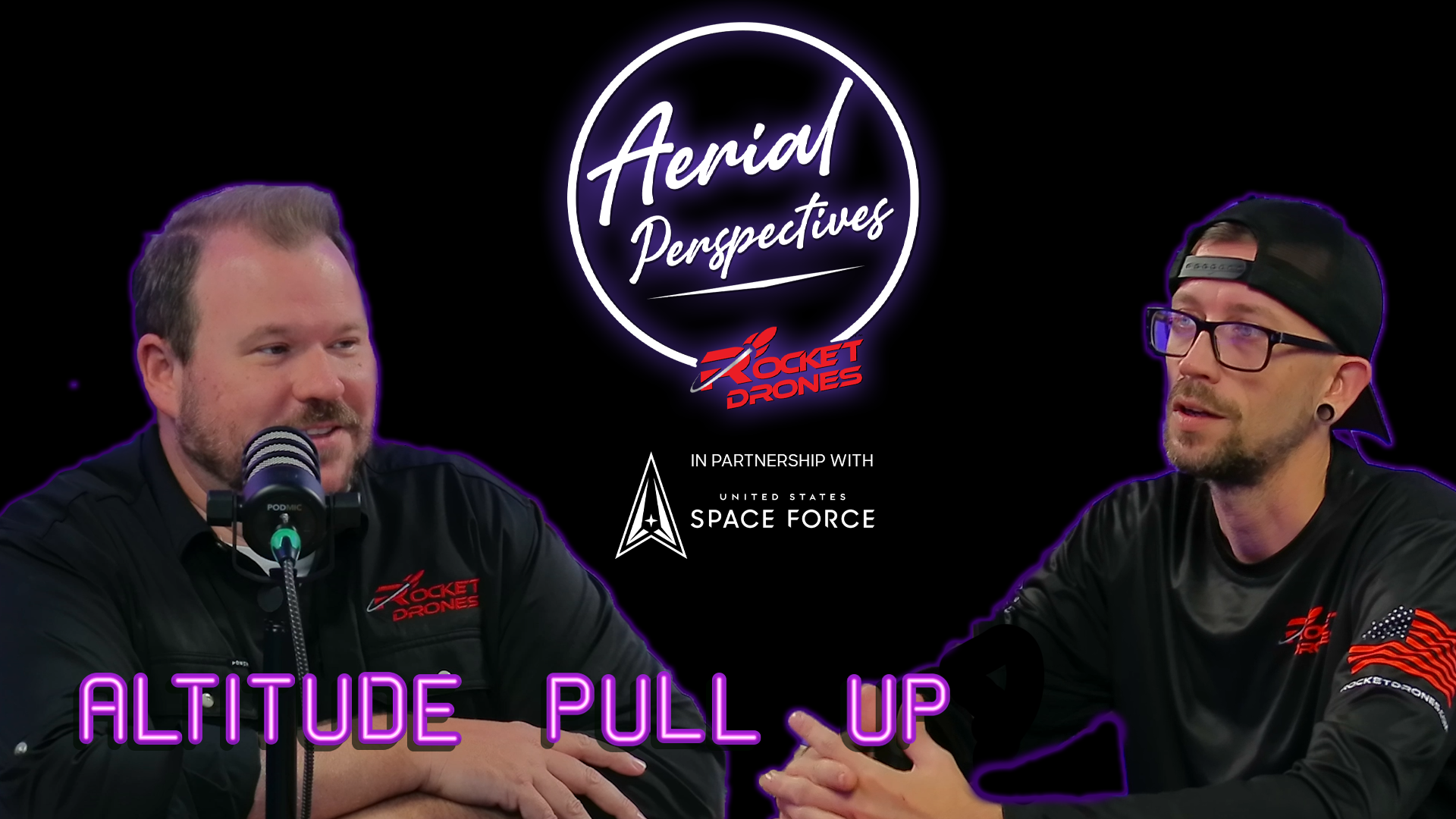
00:00:14 Chris Tonn: Well, we want to certainly take a moment to thank the folks over at Visit Alabama for having us out on that amazing shoot. It was certainly something that ended up producing a really nice looking commercial as well, which we'll show you all in this video. But yeah, Chantry Holdman everyone, part of the Rocket Drones team, Pelican Drones team, and all things drone professional. If you want to give us a little insight into how you got into this.
00:00:43 Chantry Holdman: Well, honestly, I got into RC helicopters and planes as a small kid, and then I served in the Marine Corps as a 0481 Landing Support Specialist. And part of that job was to hang out on helicopters and do external lifts with them. And my love for helicopters really grew. Around reenlistment time, I tried to reenlist and switch over to the Marine Corps drone program, and unfortunately, because I was a sergeant, they wouldn't allow me to lat move over into that program. And so I said, okay, well, I'm just going to do it on my own. And ever since then, 2010, I've been flying drones and multirotors.
00:01:28 Chris Tonn: That's super cool. I know a lot of folks in the military think it's kind of just the Predator drones only. But now we're in a whole new chapter of all sorts of applications, from surveillance to weaponry to you name it—clearing landmines off of a field. It's got multiple uses. But did you start in the military? Did it just pique your interest there? Where did it go from there?
00:01:54 Chantry Holdman: It was just a passion of mine. I've always been an aviation fan. So ultimately, I just kind of clung to it naturally because I couldn't be a jet pilot at that time. And so drones is what gave me that freedom to go ahead and fly like a bird.
00:02:12 Chris Tonn: So we started on small little RC helicopters. When did your first actual quadcopter come into play?
00:02:22 Chantry Holdman: Right at 2010. Yeah.
00:02:24 Chris Tonn: And was it the same kind of control pattern as the RC helicopters, or where else did you get familiar with it?
00:02:29 Chantry Holdman: Yeah, all the control schematics are the same. You still have pitch, you have roll, yaw, and thrust. Ultimately, it was the exact same Mode 2 configuration for the control layout. And then ultimately it felt very similar, because multirotor drones and coaxial and fixed pitch style helicopters all fly the same. And so it was very natural just moving right into it from helicopters.
00:02:59 Chris Tonn: Do you get any help from the video game world at all?
00:03:02 Chantry Holdman: Oh, absolutely. Mostly Battlefield. Yeah, that's where it all really kicked in, with Battlefield 3 on the PlayStation 3. That's probably one of the best games ever made, I think.
00:03:13 Chris Tonn: Yeah, I was right there with you. I think that a lot of drone pilots, if you referenced that—or at least some that have been flying for some time, I should rephrase—but we all have kind of had a moment in some of the games that either exposed us to similar control patterns as the drones, or somewhat easy to adapt from there. But what about when you first got into an actual flying quadcopter? What was that first chapter? Was it a toy? Was it a real deal big drone? What was it?
00:03:48 Chantry Holdman: Yeah, it was actually a really small drone. I think at the time it only had like a two or maybe one axis gyro in it, and it was fully enclosed. It was called a Skywalker. It was like in this little cage. And in the very first, I would fly it and I'd crash it over and over again. So I was very thankful it had a full cage on it. But when I got better at it, I went ahead and clipped the cage off and was able to lose some weight on it, so it was much more agile and nimble. It didn't have any type of position hold or anything else. It was just, I'm going to stay stable and fly stable, but you're in full control. There's no hovering position. So it was quite drifty at all times. So you had to learn how to counteract. And basically, it's like being out in space with one of those EVA packs. When you shoot thrust this way, you've got to shoot thrust back this way in order to stop.
00:04:44 Chris Tonn: Yeah, there's no brakes in the air, huh?
00:04:47 Chantry Holdman: Absolutely not.
00:04:49 Chris Tonn: Well, that's really cool. Did you find yourself kind of naturally leaning towards this newfound love of flying the drones towards commercial? Like, how did it ultimately connect back over to commercial opportunities?
00:05:04 Chantry Holdman: I'd seen a lot of commercial capabilities at the time. After I got out of the military, I worked as a screen printer, and I also did oil field. And part of one of the things I did—when I developed a DJI F450, I mean, that's pretty much where we all started, unless you started out on a Phantom or something—I would map the oil site and then create a 3D print of it. I would bring a printer with me and I would give that to the company man. And they're like, "You just did that?" I'm like, "Yeah, this drone technology is really cool, isn't it? It can be quite helpful." You know, trying to sell it and trying to figure out where it fits into commercial industry, because during that time it wasn't legal for us to be doing anything commercial. It wasn't until like 2016 that they really opened it up, unless you had your actual pilot's license.
00:05:58 Chris Tonn: Yeah, no, that was an evolving chapter of regulations. But it's interesting you bring up kind of helping to paint the picture for the potential business use cases that one might hire you for, whether it's a photo of the job site or a scan of the 3D assets on site, or real estate for sale. I'm sure it started to really paint the picture nicely. What happened after the oil field side of things? Where did it go from there?
00:06:30 Chantry Holdman: I moved over to Pensacola, Florida. As a matter of fact, contacted you right when I got here. And after that, we kind of—some of my friends, we got together and we created a drone racing program here in the city of Pensacola. We were quite successful in the first three years. And then I went ahead and just got busier and busier with my commercial drone work. So moved on from that and got into the whole wide world of commercialized operations. And then, yeah, the rest is history. I mean, we're here at Rocket Drones because of it also.
00:07:09 Chris Tonn: Yeah, yeah, it's kind of crazy how it feels like yesterday some of this stuff was just getting started. And you've been big on the building and design side of things. I think there was a cool project that comes to mind with a spray drone for vegetation that was growing on a hotel exterior in New Orleans. You want to bring us up to speed on that one too? That was fun.
00:07:37 Chantry Holdman: That was very interesting. You had a client, as a matter of fact, that wanted to kill plants that were going on the side of their building there. And we only wanted to do it with like a Phantom. So the payload was very small. It was probably about the size of a can of Coke—about twelve ounces of fluid. It flew not very well due to the shifting of the water inside. But ultimately it did spray, and it would have done the job with a skilled pilot behind it. But I think they found it a little bit easier at the time to just send somebody over on a rope.
00:08:22 Chris Tonn: Yeah, well, it's amazing to see the ability to take an idea, bring it to life with 3D printers, design, a little bit of parts from another world of Walmart.
00:08:37 Chantry Holdman: Exactly. Got the spraying system and apparatus from the bug spraying section. And then I modified it to be radio controlled, and so then I could just spray it, and it had its own little pumping system all built in. It screwed right onto the Phantom, and it was just a little modular package. It was pretty good.
00:08:59 Chris Tonn: Yeah, I think that's one of the keys to your pathways of success is that you said yes a lot along the way of building things and flying missions. And I want to say there was a unique one when it comes to disaster response that you also got to be privy to. What was that?
00:09:20 Chantry Holdman: Hurricane Matthew or Michael—it confuses me so much to this day. But it was over there in Bay County of Florida. Worked directly under Bay County EOC, the Emergency Operations Command Center, and Florida State University and Florida UAS Group. And basically we got parachuted in to do disaster response route clearance. And then ultimately we mapped all of Mexico Beach, where the storm actually made landfall, to do mapping studies. And then our data ended up on the USAA website. And it was really cool to be a part of.
00:10:04 Chris Tonn: Yeah, that is, I'm sure, a different scenario of now you're going into a disaster site that doesn't have power. You need to charge batteries. You need to get footage to where it needs to go. You were probably dealing with some new challenges altogether. But that's what, really, I think, has made you resilient. But you tell me—what was the most eye-opening of that journey in itself, besides the sheer destruction? That was a Cat 5 storm.
00:10:32 Chantry Holdman: Yeah, so very much so. It was like being in a war zone. I've been in one of those before, and it was very similar. Ultimately, we were having to cut our way in. People's homes were completely destroyed. They hadn't had contact with anybody since the beginning of the storm. A lot of times we were cutting into neighborhoods and people were like, "What's going on? We lost power. We don't have any way of knowing what's going on or anything." So it was very chaotic. Power was limited. We were running little two-stroke generators in the back of the trucks at all times, keeping our batteries charged. Ultimately, there was some crime going on, so it was kind of dangerous. We had to have a member of our team kind of looking out for us at all times because people were getting into some bad trouble stealing from stores, you know, just trying to get basic necessities or whatever. And it was just like I said—it was just like a war zone. You didn't know what to expect or what kind of conditions or what you were going to be facing that day.
00:11:47 Chris Tonn: Yeah. Well, that's what makes these drone missions—never is one the same as another, in some cases very extreme ways. Well, tell us a little bit about some other fun projects. I know you've got a few. I know you ended up in the advanced piloting side of FPV that's led to some stuff. Tell us, what's been your favorite project to work on?
00:12:08 Chantry Holdman: Oh, by far, the Delta V or the Saturn V rocket. That to me—I'm such an aviation and space nerd. Most of my most prideful pieces of work have to do with aviation. So whether it be the Saturn V rocket, or it be the National Naval Aviation Museum here in Pensacola, getting to fly around all those historic aircraft. Or it could be flying the LCS ships out there in Mobile Bay, just being kind of back into the military world and being able to fly and show off my skills is kind of like, "Ah, see? You know, you shouldn't have let me go."
00:12:51 Chris Tonn: Yep. That's right. That's right. Because now let's fast forward for a second. Marines are now making a move to be all equipped with drones.
00:12:59 Chantry Holdman: Yeah, the saying has always been "every Marine a rifleman." Now it's kind of like every Marine a drone operator now. With the advancements of the drone technology in the battlespace, all the way up to the Space Force back here, where they have people that utilize drones all the time. The satellites—what is that? That is a big, giant drone. And you remotely control it. So they need all kinds of smart people in their ranks.
00:13:26 Chris Tonn: No, absolutely. It's a changed environment, to say the least. But really cool that you were early to it at the same time, and enjoying those times with the drones. Well, what about some of the not-so-fun stuff? Obviously it's always fun to reminisce on the good stuff. But were there any challenging moments where you felt like, wow, this is really probably one of the more challenging areas that I've messed with? Is it in the building sector? Was it in the pilot side? Where was it?
00:13:55 Chantry Holdman: The building is always tough. When you take on your first FPV drone, learning how to solder, learning how to program, tune, and get all those settings dialed in just right to your flying style, and then also ensuring that it's not causing micro oscillations in the footage—that's like climbing Mount Everest. When you first start out, you're like, "How in the world am I ever going to get up to the top of this mountain?" But you keep chipping away at it and don't give up. And eventually you see yourself at the top, looking around and enjoying the view.
00:14:32 Chris Tonn: I love it. That's a beautiful way to look at it. And I know it now blends with other skill set areas. Like for example, I guess you could be a really good drone pilot, but if you're not smooth on your turns or you're not being respectful of what looks good on camera, you have another area of skill set to unlock. Did you find the camera side to be like an enjoyment of extra drone stuff, or was it just a whole other box?
00:15:03 Chantry Holdman: Yeah, I grew up taking pictures. I always loved operating cameras because my mind's really mechanical, and I always wanted to know how things worked. And so cameras was one of those things. And I'd always had a great appreciation for nature and just what beauty you can find. And so the additional bonus of having these high definition cameras on these drones was just—it's like being completely free. Like I say, you're the bird and you get to find beauty and capture it. So that's what's led up to my skill set and further pushing me into this world.
00:15:43 Chris Tonn: And what's your favorite kind of drone to fly?
00:15:45 Chantry Holdman: FPV, all day, every day.
00:15:48 Chris Tonn: Any particular size or class of FPV?
00:15:53 Chantry Holdman: Probably two and a half inch. Two and a half inch is well within the legal—usually below 250 grams—so it opens up a little bit more of the rules and regulations where you can and cannot fly. And ultimately they're just so fun, agile, and fast that you really can go anywhere with them and feel completely safe. You can go to a park, you can go to the beach, and it's not really overly threatening to anybody. Also the Tiny Whoop size class drones—65 millimeter wheelbase diameters—those are probably my favorite because I don't even have to leave my front room. I've got a full little drone racetrack in my house right now.
00:16:38 Chris Tonn: That's so cool. Well, that's the fun part of this side of it too—sometimes you can't tell the difference between work and play. Well, what about your favorite style of drone FPV flight? Is it freestyle or are you into racing?
00:16:56 Chantry Holdman: I mean, freestyle is free and natural, but racing is adrenaline packed, and I love all of it. Ultimately though, the cinematography side with FPV flying is where I really enjoy because I've learned how to freestyle, I learned how to race, and now it's like, how do I make money? How do I continue doing this as a job and progressing my skills? Because the first two was all about rapid movements and it can be quite jerky. And when you get to racing, it's like, okay, now fly the course and do all these maneuvers. But cinematography really brings that professionalism into it to where you're on a music video set or you're on a movie shoot, you've got like these once or twice opportunities to get the shot right. And then, because the drilling gets flowing—it's a high-pressure environment. Like especially if pyrotechnics are on the line or something, you've only got sometimes that one shot to get it right. And so while I'm flying I'm okay. But as soon as I'm done, I'm a nervous wreck. I'm like, "Okay, guys, I'm gonna need to calm down for a second and let this adrenaline wear off, and then I'll be able to answer any questions and review footage."
00:18:21 Chris Tonn: Nice. Nice. Well, what's the next project in line for testing your skill set?
00:18:27 Chantry Holdman: Let's see. I think we got a golf shot coming up, so they're wanting me to fly and chase a golf ball. So that's going to be really neat. We're gonna have a professional golfer do it as safe as possible, utilizing a smaller drone set. And they want that swing and that Tom Brady shot basically that got viral like two years ago.
00:18:53 Chris Tonn: Yeah, that was a cool shot. And that was the hole-in-one shot of all things on the first take.
00:18:58 Chantry Holdman: That's incredible. Like, I still don't know how they managed to get the timing right, the shot right, and everything all in one take. But they did.
00:19:09 Chris Tonn: Well, that's so cool. Well, what about some of the things that you have for advice for some of the younger generation that's getting into this field as far as where do they start? Where are the areas to focus the most on?
00:19:22 Chantry Holdman: Definitely practice, practice, practice on a simulator. That's the number one key. It saves so much money. And then once you do get into that physical drone, start off with a small one, get the stick coordination. Because now you're fighting environment—it's an invisible force up there. The only thing you can do is react. You can't be proactive unless you absolutely know what those conditions are. And so once you develop how to react to those invisible forces, then start moving up in that size of drone and get more and more comfortable. Ultimately, go from freestyle, which I think everybody kind of starts out with in FPV, and then move into the racing to get those fine motor skills, and then ultimately onto your professional career, whether it be cinematography, fire, EMS, agriculture—it doesn't matter. But ultimately it's going to take you through multiple stages of self-regulation and stress management and different things that you're going to learn through that process. Because even while I'm shaky, that only happens after the flight. During the flight, I'm rock solid, ready to roll. It's just due to that experience over the past fifteen years of just continuously going. And then don't be afraid to crash. Ultimately, if you're not pushing the boundaries and you don't crash, you're not learning. So push those boundaries. Push yourself harder and harder. How do I make it around the course faster and faster? And if you crash, you crash. Sometimes turtle, get back up if you can. If it's completely down and out, that's just how racing goes sometimes.
00:21:22 Chris Tonn: Yeah, you bring up a good point too with the simulator and the crashes. It's so much more affordable to be able to press the spacebar and reset than some of these drones that are out there. Because in the beginning chapters, the drones were crazy expensive for professional work. There's also the build your own. But it felt like if you crashed one of those ten thousand dollar plus drones, it might scare you enough to walk away.
00:21:53 Chantry Holdman: It is a bad day. Even the thousand dollar ones hurt big time. The bigger the drone is, they're kind of easier to fly. They've got position hold, they've got radar sensors and stuff like that. But ultimately, you just got to fly mindful of what you're doing, how close you are to that building, whether you're doing inspections or cinematography. Just continuously keep that situational awareness about where the drone is and what's around your airspace and who's below your drone too. Because at any moment—I've even had it on one of our shoots, I was sixty feet up in the air and all of a sudden complete loss of power in the drone because the battery lead vibrated out of its plug holder. And that drone fell down and smacked the ground into a lot of pieces. But luckily I wasn't over any of the vehicles. I wasn't over any people or anything. And so it was just a drone that was broken that day.
00:23:01 Chris Tonn: Yeah, it's interesting you say that—the amount of discipline that it can take to not be over people and cars and things of that nature, because these things do happen. And it's a balancing act that's probably going through your mind when you're flying—safest path, best shot, everybody is timed right. All of those things probably going through your head. But at any given moment, a failure can occur. Could be a bird strike, could be anything.
00:23:36 Chantry Holdman: Yeah, it happens. Birds will try to grab your drone right out of the sky. Sometimes, like I said, you'll lose power or you'll lose an IMU or something. It's almost—if something doesn't go wrong on the shoot, I get really worried because there's always usually some hurdle to overcome. And if everything goes right, I get a little sketched out. I'm like, "Uh oh, is the footage okay?" And so I have to review the footage real quick, make sure I hit record. I mean, that can happen too.
00:24:08 Chris Tonn: Well, give us a little insight on the world of FPV pilot pay, because I know it can range from something like super simple flying through a little quick house to something where we're in a national TV commercial flying through a Dodge Ram window and out the other. What are these pay ranges in the FPV film category?
00:24:30 Chantry Holdman: I mean, for me personally, I kept it pretty clean and simple and charged a flat hourly rate. But ultimately, you can move on up into these bigger projects. Sometimes it's like fifteen hundred dollars a day. Sometimes it's ten thousand dollars a day. It really depends on the project and your skill level, whether or not you can perform, and whether or not you already have the equipment and have backup equipment for the equipment. Because that's also part of the art of the game too—if you crash your drone on set and you don't have parts, you're offset, somebody else is on. They're not going to wait on you to "hold on, I gotta send it off to the company and get it back two weeks later." You're on set that day, so you have to fix it that day.
00:25:27 Chris Tonn: So in addition to flying safely and capturing the shot properly, you've got to be able to communicate and turn around with any issues that occur. What's been a little bit of a glimpse into the customer experience side? Do you show the customers the shot? Do they give input? You do it again? Where have you found some of the strengths in working well with your clients?
00:25:51 Chantry Holdman: I try to do exactly what they ask. Sometimes they're really well versed in what the drone's capabilities and what pilots of this style can do. Sometimes not. But ultimately, I try to give them what they want. And then when I find those little moments that I can just kind of like, "Hey, check this out"—they usually end up going with that shot.
00:26:15 Chris Tonn: Yeah, that's interesting that your experience can sometimes show a shot that may not have originally been on a storyboard, or just from flying around and getting the feel for the area. So that's really cool. Well, what else is coming in the future—not just your work, but the world of FPV? What are we seeing around the corner? What's next to come in the hardware space?
00:26:41 Chantry Holdman: We're going to see more and more smart drones come out of manufacturing. More manufacturing houses are going to start opening up in America. Ultimately, our military and our law enforcement, pretty much every industry is going to be wanting drone pilots. If you have the manual flight skills, you're going to get a lot further in advance amongst your peers, because those manual skill sets, especially for law enforcement, military use—highly requested. Because you can do the things that most drone pilots can't. Some drones won't even allow you to fly too close to a building, let alone fly through the window.
00:27:29 Chris Tonn: Well, it's like you just said a minute ago, if something's not going wrong on a shoot with the drone, something's wrong in general. It's funny how often technology is great when it works, but with drones particularly, they are throwing you curveballs left and right.
00:27:47 Chantry Holdman: And yeah, you got to be adaptable to every situation. So whether it be environmental winds—all of a sudden a squall line could be coming in, like the Saturn V shot. We were set to go at this time, and but all of a sudden this huge squall line came moving in in the weather pattern, and we had to get rolling really fast. So everything got rushed really quick. And then it played havoc on my nerves. But once I got goggles down and I said, "Okay, here we go," my piloting and all of my training kicked back in and I was able to get the shot.
00:28:26 Chris Tonn: Yeah, I forgot about that storm. So just to give the audience a little bit more insight on that particular shoot—you were off to the side, set up, goggled up, ready to fly. Give us kind of that play-by-play of how that went. And was there talent involved?
00:28:47 Chantry Holdman: So about thirty minutes before that shoot, it was almost windless. It was like a breeze. I was like, okay, this is perfect, because if there's wind, it could throw you off of your dive, it can push you around up there. And everything was doing just fine. I couldn't really gauge the wind because there was no flags out anywhere around that campus at the time. So I didn't know which particular direction the wind was going to be coming from once the squall line kind of kicked in. So ultimately, I had to go and give a few practice dives to understand what was going on four hundred feet up in the air. And then at the same time, what kind of venturi-like wind turbulence effect is that rocket giving off too? So ultimately it took me like four or five good solid dives to realize that I had to be off the rocket about forty to fifty feet to the right of it in order to start my roll. Because if I tried to just flip over it right at the top of the rocket, I would end up forty to fifty feet off to the left of the rocket. But once I got that line dialed in and kept dropping and dropping, and the director was working on his timing, getting everybody to move in one smooth sequence—it was very challenging. But ultimately it was repetition, repetition. And then finally I had one or two dives where everybody was like, "That's the one." It was just inches off the rocket. Come down, see the family. We were flying off to the side of the family for safety, because ultimately I'm coming down at mock speed—really, really fast coming down that dive. And then I have to J-hook, kind of pull out, and then get smooth at a tree line area to see this family walking down the hill. And I hit the trees a few times. The actors were kind of scared and ducking in some of the takes. But once we all got used to what was happening and what needed to go on, it was just—it made magic.
00:31:06 Chris Tonn: Yeah, no, it certainly did. And all while an approaching squall line is on the way.
00:31:12 Chantry Holdman: I think that battery—as soon as I unplugged it, it started raining. So it was just in the very nick of time.
00:31:23 Chris Tonn: Yeah. No, that is so cool. Well, any other just exciting stories while we're on story time? Because people love hearing some of these behind-the-scenes sides of it all. And I know that you've been on some exciting ones. That one's probably one of the more spicy stories. But any others come to mind, or any other passion ones that you really enjoyed?
00:31:47 Chantry Holdman: I flew through an F-18 Hornet.
00:31:50 Chris Tonn: Oh, yeah.
00:31:51 Chantry Holdman: From intake through the afterburner. And I was the first person to ever do that through an actual jet. And it was kind of my own silly way of like, "Hey, this is exactly where a drone shouldn't go, but I'm getting to go anyway." That's why I really wanted to do that. And I got to do that in the restoration hangar of the National Naval Aviation Museum for some project work, for some documentaries and stuff. So that was really fun.
00:32:20 Chris Tonn: That is—wow. Well Chantry, you've certainly been on some projects to keep us all wanting to do more, to say the least. But any other just little tidbits as we sign off here? Want to give any other insights of how else to get involved with drones and how else to kind of just tear down that barrier a little bit?
00:32:46 Chantry Holdman: Yeah, don't stop learning. Ever. Never stop. Learning is power. Knowledge is power—it's been a saying for a long time. And it's true. The more you learn about drones and what their capabilities are, from orthomosaic mapping to LiDAR to drone delivery, everything all the way up into the satellites—it's limitless. And you have a career available in this technology. And it's up to you how far you actually go.
00:33:21 Chris Tonn: Couldn't agree more. And super thankful to have you on the show. And that's another episode of Aerial Perspectives. Thanks for tuning in.