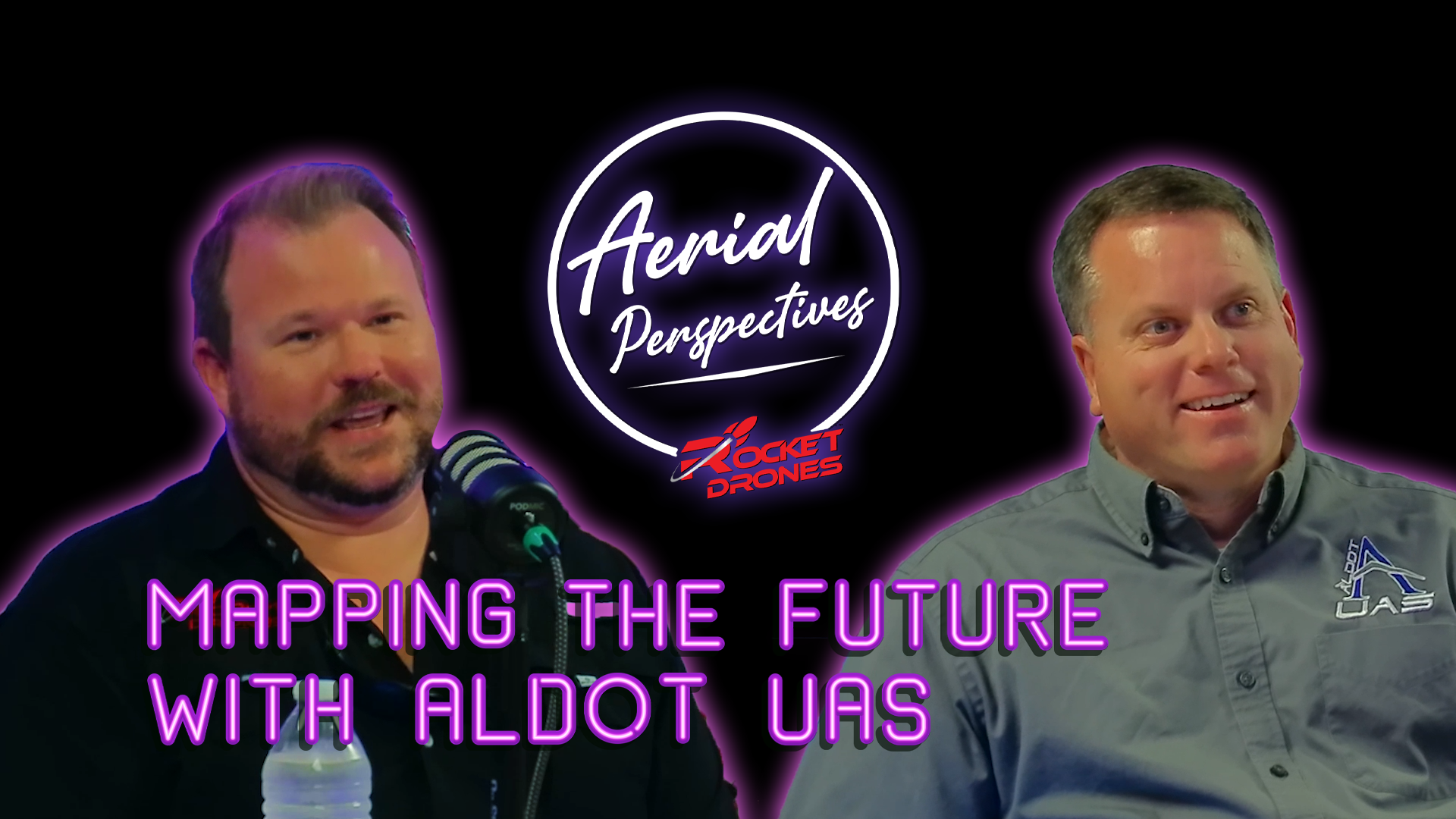
Episode 3: Aerial Perspectives - State DOT Drone Programs: Construction, Bridges & Disaster Response
Guest: Jonathan Woodham (UAS Manager, Alabama Department of Transportation - ALDOT)
Host: Chris Tonn
Location: Rocket Drones Studio
---
00:00:00 Chris Tonn: All right, guys and gals, we're back again for another episode of Aerial Perspectives. I'm your host Chris Tonn, and today we have another special guest, Mr. Jonathan Woodham. So Jonathan, great to have you on the show.
00:00:12 Jonathan Woodham: Good to be here.
00:00:14 Chris Tonn: Absolutely. Welcome to the podcast.
00:00:16 Jonathan Woodham: Yeah, should be interesting. Love to hear that.
00:00:20 Chris Tonn: Well, I've got a little brief intro about you, and then we'll dive right in.
Joining us today is Jonathan Woodham, UAS Manager at the Alabama Department of Transportation, where he's been pioneering drone operations since 2016. Jonathan played a key role in establishing ALDOT's UAS division and has led numerous projects with a focus on construction and environmental initiatives.
He particularly enjoys the precision and hands-on skill of manual flying, which he puts to work in ALDOT's diverse range of projects. Notably, he was part of the team that won the 2020 Civil and Structural Engineering Drone Video of the Year.
Jonathan is guided by the motto: "There are two things you control—your attitude and your effort."
So with that, again, welcome Jonathan, and thank you so much for the time.
00:01:15 Jonathan Woodham: You're welcome. It's actually ALDOT, yes. Thank you for that. Each state has their own—F-DOT, M-DOT. There is an A-DOT, but we go by ALDOT.
00:01:25 Chris Tonn: I'm guessing I was dropping a little love to Alaska in that case, maybe. Well, no worries. And thank you again for being here. Obviously, always like to kick off the show with a little bit of background on how you first got involved with drones. Where was kind of the first time you were exposed to a drone?
00:01:48 Jonathan Woodham: It was at a vegetation conference of all things. My previous life at ALDOT, I was an agronomist, so I was involved in the vegetation management side of things. So anything that wasn't a bridge, concrete, or asphalt—we kind of dealt with the herbicide program, mowing program, that kind of stuff.
So we were at a national convention in Roanoke, Virginia. I think it was late 2015. There was a speaker there who was talking about how his company was using drones for asset management—guardrails, bridges, signs, that kind of stuff.
And so I got home, talked to somebody in our front office, and I said, "Hey, I was at this conference. They were talking about this." He said, "Well, it's kind of interesting. Our director, Mr. Cooper, was at a conference not too long ago where somebody else was talking about this. And he came to me and said, maybe ALDOT needs to look into this to see if this is something that would be beneficial for us as a department."
So early 2016, JD Darville, who was my boss, a guy named John Russell, and myself were kind of approached and asked if this is something that you would be interested in starting, or see if this is a viable thing for us.
So we had current duties in 2016—I was still doing the agronomist stuff. And then when we had time, we would do drone stuff. It took about three years for us to get the positions done through state personnel, because there just wasn't anybody else. You can't go look at another state or this other industry to see what are the qualifications for this position.
So it was a really long process because of that. It really took three years. And in January 2019, I officially became UAS Administrator, and drones was the only thing that I did. JD was the Administrator—drones was the only thing that he did at that point in time.
00:04:00 Chris Tonn: Very cool. And was this something that at the time when y'all were at this conference—was it something small, big? Was it—
00:04:05 Jonathan Woodham: There were probably 300 people from across the country at this. And it was one of the larger asset management companies for infrastructure that was starting to use drones. I think they're based out of Texas. And just kind of happened. I thought it was kind of neat. And said something, and the big boss said, "Hey, this is something we need to look at." Just kind of snowballed from there.
00:04:25 Chris Tonn: Did it become something that, once you got home, personally, that you wanted to explore even further on the personal side? Or did it stay more of a work focus? What was the—
00:04:35 Jonathan Woodham: A little bit. You know, everybody goes and buys those cheap $20 drones, and they end up getting caught under the couch, or they fly away. And I was like, this is madness. I don't know that this is quite what I want to do.
Then once you start getting into the industry, and back then it's the P4—so when you fly something that has GPS outside, it's a whole lot easier than a $20 drone you bought at the middle of the mall kind of thing.
And so once you start getting in there and realizing, "Hey, this isn't an impossible thing to do," it does become a lot more fun. And like, maybe there is a career path here.
00:05:15 Chris Tonn: No, absolutely. Well, was it very much longer that you had a personal drone and started to gain some experience beyond the indoor ones? Did you go to like the Phantom 4 and things of that nature?
00:05:30 Jonathan Woodham: No, it worked out to the point where I was getting enough flight time in at the office where I didn't necessarily need to go out and, "Okay, what am I gonna do this weekend to work on my skills?"
We get plenty of that at the office, and I was getting my fill at the office. After a little while, we became so busy that drones were pretty much my—my agronomist boss was like, "Hey, I know you got a lot of stuff going on here." So he took some things off of my plate, which allowed me to focus more on the drone side of things.
So my cup was getting filled up at the office. I didn't feel like I needed to go out and spend all weekend working on the skills and that kind of stuff.
00:06:16 Chris Tonn: Now that makes total sense. And just going over to Pelican Drones' side of the business—on our side, we were involved with Florida Department of Transportation on two larger projects in the area just around that same time, about 2016-2019 window. They were redoing a section of I-10, and they were redoing the Three Mile Bridge between Gulf Breeze and Pensacola.
And what was really neat about it was they were using these images to track not just the progress, but also kind of what's going on with risk mitigation, what's going on with certain weather aftermaths if they've had a big storm run through, also where the supplies are—are they in the right staging areas—and who's on site this day, who's not on site this day.
00:07:00 Jonathan Woodham: Yes, we're being charged for—
00:07:02 Chris Tonn: Exactly, exactly. And it quickly became so interesting to me that DOTs across the country would be looking at this technology to not just monitor progress, but to do so much more on volumetrics, getting into the risk mitigation, other things.
Can you tell me a little bit more about how that kind of started when you guys started to dabble with the asset management, but how it grew into much more?
00:07:41 Jonathan Woodham: We found it kind of difficult, because a lot of large organizations, established organizations—"This is the way we've always done this. So why are we going to look at doing something else? The way we've done it in the past has worked for us."
So we faced a little bit of a struggle in the beginning of that, but luckily, we had all the backing in the world from the front office. And for a DOT type situation, if you don't have backing from the front office, it's going to be very difficult for you to be able to get a program like this started. So they were very instrumental—"This is something we're going to do. This is something everyone needs to look at."
And once you started doing some things for people and they realized, "Hey, we're not trying to take your job away"—I had a bridge inspector tell me, "You're not taking my job away from me." And I said, "You're right. I don't want your job. I want to help you do your job. I don't want to be a bridge inspector because I don't want my name on that form if something happens. You have a need for pictures that you can't get to—call me. That's how I want to help you."
But our big breakthrough—we were flying a project in Mobile, I-58/98 corridor going to Mississippi state line. We're flying some stuff down there. And our stormwater coordinator for the Mobile region came and was like, "Hey, what are y'all doing?"
And so we showed him—"I see three things right now because the contractor needs to fix." He said, "I want you to fly all of my projects." And so he had four or five projects going on at that time.
So every six weeks he would have to go out and do an inspection, either walk or drive that project. Well, if you're walking, this is a seven or eight mile project—it's too much. You're not gonna be paying attention by halfway through. You're gonna be like, "I don't see anything." Or drive down the road. But when you're 200 feet over the project looking down, you see everything.
And once he realized that was going to be a great asset for him, he said, "Do everything that I've got. I want you to do it every six weeks."
And we're like, "Okay." So we started talking to some of the other stormwater coordinators, and it just kind of snowballed from there. And I would say probably 80-85% of what we do is construction/environmental related projects.
Because we've got so much going on for the state, and the environmental side of things is such an important aspect of what we're doing, that for us to be able to go out there—we can find something, and within an hour, they can have the information that they need.
Software that we use—we can upload it, it processes it and sends them an email saying, "Hey, panos for whatever project are available for viewing." They can get on there, look at it, and say, "Hey, we've got issues. We need to call a contractor."
We had one—we flew, that contractor called and said, "Hey, I'm out of rock. I need to buy some more rock." And the guy's like, "No, you got bigger problems. You've got the wrong rock out there." He said, "No, I don't." "I'm looking at the pictures from an hour ago. I can tell you've got the wrong rock out there. You need to pull all that rock up and get the right rock in there first."
But he didn't even have to travel to the project. He could look at everything from his office. So it's saving him time, saving the state time and money by not having people traveling all over looking at these projects. The information came straight to him.
So once those things started happening, they started talking to other people across the state and saying, "Hey, these guys have really helped us out. You need to be using them." And then they would say, "You know what, let's give it a try." And everybody who has been a naysayer on the front side has come around and said, "Hey, it is beneficial having you guys around. You're not going to take our jobs."
00:11:15 Chris Tonn: You're sounding like drone business experiences in a nutshell. Once they see it, it's such a "How did I do this without it?" kind of moment of realization.
It's interesting too—I feel like that's how ChatGPT, in a way, helped AI just grow awareness-wise so quickly. It's like, "What do you mean? I just gave it five ingredients, and it just gave me 50 recipes that I could make." It was a very eye-opening exposure moment.
And in drones, when you take them to somebody's workplace and you show them, either A, how we can be more efficient, or B, in your case, how you just discovered three things right off the bat that helped this person save money or catch it before it started going even further and more costly—it just continues on and on of benefits that folks see.
And one that you may have touched on but didn't identify directly is some of the imagery that we can see helps us see how the water runoff or the elevations change on the ground. So with environmental, for example, as you were saying, I'm guessing y'all can use that to say, "Hey, this isn't in the optimal degree of tilt or whatever it may be for runoff." Is that something y'all use too?
00:12:30 Jonathan Woodham: Somewhat. More than likely what we're looking for, or the stormwater coordinators are looking for, is—is the sediment staying where it's supposed to be staying? So are the best management practices of the hay bales or the silt fences, those kind of things—are those up and operational? Because if they're not, that's a problem. It's a major problem.
But you can also see that from the drone imagery, either with an ortho or panos, depending on the size of the project. We may do both. We also may do a photo plan that's looking up river, down river kind of thing, so they've got historical data from every time we've flown it.
So they can scan or slide back and forth and say, "Okay, we got a big rain. Nothing happened. We're looking good right here." Or, "Hey, we just flew this. There's mud outside the area. It's not supposed to be. Y'all got issues."
We don't get too much into the "Hey, this is not correct." We let the experts on that do that. We just give them the information they need to make that determination, which takes a lot of pressure off us, because we're just having to call somebody and say, "Hey, you've got issues" or "Hey, we've got issues, we need to go."
00:14:00 Chris Tonn: And I imagine everybody appreciates that. Everybody's there to help. It's just now you've got better views.
00:14:10 Jonathan Woodham: Yeah, sometimes the public's like, "Hey, what are y'all doing?" And I'm like, "Sir, they just sent me to take pictures. You call this number if you've got any questions." A lot of times they're just curious about what's going on. It's flying around. It's doing fun stuff, supposedly.
00:14:30 Chris Tonn: Well, speaking of some of the sideline usage—is there a favorite drone mission that you were ever on, or just a fun one where you felt like, "Wow, that was a neat story" or "Wow, that was a neat experience" where now you're able to put that under your belt?
00:15:00 Jonathan Woodham: I wouldn't say this is a fun one, but a couple years ago when the tornadoes came through and literally destroyed the city of Selma—we got a call, or my bureau chief came by my office.
It's either Thursday afternoon or Friday morning. He said, "Hey, the director has told the mayor that we can get out there and fly all the storm damage. Is that something you can do?"
I said, "Absolutely, give us a little bit of time to kind of get a game plan together."
So it was Martin Luther King weekend before that. So we went out Friday, Saturday, Sunday, and Monday—the only weekend and holiday I've ever worked for the DOT—and we flew from sunup to sundown, basically working 9, 10, 11 hours a day.
There was four or five of us out there. So we were taking pictures, we were doing videos. We literally mapped the entire storm damage from city limits to city limits.
And it was an eye-opening experience, because you see—the storm does not discriminate. You had the country club got leveled, and you had people who didn't have anything. They're both in the same boat. They don't have anything to move forward with.
So that was not a fun one, but that was one that really sticks out.
00:16:34 Chris Tonn: No, I know. In my mind, I can only imagine. I was deployed to Hurricane Michael after Panama City got basically that Cat 5 direct hit over at Tyndall and everywhere else. And I saw major power lines down—high transmission, the ones you don't usually see down—water towers down, train cars on their side, just absolute carnage. And it was just an eye-opener, to say the least.
And it's been one of those that I think you grow to appreciate, one, the situation, and two, how this technology can sometimes really provide a quick solution of eyes in the sky of what's going on with the damage. Or in some cases, it reestablishes communications. I know that AT&T and Verizon have some really cool solutions where they can put—where there was a damaged cell tower—they can put up a drone that's powered through a tethered line and a data line, and they're shooting out data for a mile radius and getting folks right back up and running.
00:17:44 Jonathan Woodham: That was a tough one for our team. We've got a phenomenal team at ALDOT, and nobody complained. You're not taking a break, you're not taking a lunch, you're just getting out there to get the job done.
And we were able to get everything flown, processed, and delivered within a week to the city engineer for Selma.
00:18:10 Chris Tonn: That's another thing we don't talk about sometimes—the level of imagery and how it does take a minute to sift through, especially mapping, getting it up there geotagged and then put into the hands of those that can better use it. Did you find that to be one of the larger footprints that you've done?
00:18:30 Jonathan Woodham: It's the second largest one we've done. So we were flying with a 42-megapixel camera. So as you know, the bigger the camera, the bigger the data.
So we found that one image from a 42-megapixel camera is roughly three times larger than a 20-megapixel image that we take with one of our quadcopters after it's been through the processing side of things.
So we would have one pilot—would have three or four videos spread out watching everything. We got one guy whose only job is watching the airspace. You got people flying over in planes just wanting to look to see what's going on, and you're having to deconflict airspace.
So you can't do anything like that without a good team. And we've been very fortunate at ALDOT to have a core group of guys who've been with us for a long time to really help out with that.
But like you're saying, you don't realize how big stuff gets when you're dealing with a project that big. We had West Alabama Highway—they're four-laning from Mobile all the way to Tuscaloosa. Most of that's been done. There's like a 75-mile stretch that's not done, and they were having some issues with the survey, and they needed to see what all was out there.
And so, "Okay, when do you need this done?" "Like yesterday."
Okay, so the team loaded up. We went over there. There's another project where we worked from daylight to dark, and no complaints out of anybody on the team.
But it ended up being, I think if I remember correctly, 37,000 images. And once everything was processed, it was just under four terabytes of data.
Then I walked it across the hall. I was like, "Don't know how you want to open this, but here's everything that you've asked for."
So we're flying basically a 75-mile corridor that's 300 feet wide from Thomasville area of Alabama up to just outside of Tuscaloosa.
00:20:45 Chris Tonn: Wow. That's something I'm sure those that got the imagery really appreciated, and obviously it's probably even made its way over to some studies. I imagine y'all share some of this data with universities. Or where did the—
00:20:54 Jonathan Woodham: I know some of the data got moved to—think maybe Auburn or—some of the Selma stuff, some other people were able to get that.
We use that stuff for FEMA reimbursement as well. We fly all of our office properties across the state every year. In case we do have storms that come through, we can say, for insurance purposes, "Hey, this is what it looked like before."
For FEMA, the UAS team was able to, I think, get around $4 million back from FEMA, because we were able to say, "Hey, this was a debris site. We took care of it. It's back to what it looked like before."
So we found out that some of the paperwork may not have been done right, or the inspection may not have been done right, but we could go out there with the drone imagery and say, "This is what it looks like." It's backup.
So we do that once a year now as well.
00:21:50 Chris Tonn: I love that. There's nothing better than drone imagery. Nothing really escapes the eye of the drone when it comes to backing up what's been done.
Well, as far as drone missions go in regards of those MacGyver moments, or just interesting "Wow, we powered through something really challenging today"—were there any other stories that kind of come to mind as a challenging one?
00:22:15 Jonathan Woodham: Bridges. I can imagine bridges are fun.
They're the most technical, challenging things that we do. And the way ALDOT is set up, we go through 20 hours of training when you first come on board. It doesn't matter if you have one hour of flight time or 10,000 hours of flight time, you'll have 20 hours of in-field, on-the-sticks training with our training coordinators, Mike Kaiser. There'll be some other guys as well that will take you out and get you exposed to all the different types of projects we do.
Projects may consist of one photo, or it could be 40,000 photos. It just depends on what's needed.
We also have a bridge training class that you go through as well. We've got a group of instructors up in Huntsville called Energies. They really helped us in the beginning of our program with a lot of our training and stuff, but they handle our bridge training class.
So you also have a couple weeks of bridge training where you have a final exam down on the Cochrane Bridge in Mobile. Which is fun at times.
Unfortunately, I came real close to the bridge one time, and that wind was real something. Something happened—that was a cross in my office now with a wreath on it due to the loss of the drone from that bridge.
But us being able to take a drone that's 24 inches wide and stick it in a space that's 36 inches wide, and be able to move it, take the pictures, get the information that's needed—it's something that I think our whole team prides ourselves on.
Because you're in a GPS-denied environment, you're in low light. You can't see the drone. You're relying on your spotter. You can see what's in front of you, but you can't really tell how far away you are from the girders.
And there's situations like over railroads that we may not have the ability to get our snooper trucks underneath because the bridge deck is too close to the railroad tracks, and there's not enough time to get the truck out when the train's coming. So we couldn't inspect those sections.
So we went right around with the bridge inspectors on "How can we do this?" Let's just put goggles on the bridge inspector so the bridge inspector can control the gimbal. He can take a picture, a video by tapping on the goggles. We're not the ones doing the inspection. He's still doing the inspection. We're just putting him in a position to be able to get his inspection done.
So those things are—we all kind of like doing that. It's tricky. It's nerve-wracking. You feel like you've run a marathon after minutes. Adrenaline's up in between the girders. But those are the ones that I really enjoy doing.
00:25:10 Chris Tonn: Well, that's really cool that y'all also are sharing with those field experts. "Hey, here's the tools in my toolbox. Maybe you'd like to wear the goggles. You can take pictures. You can move the gimbal. It won't bother me flying." And now all of a sudden, you've got some teamwork, which makes the dream work.
00:25:30 Jonathan Woodham: We try to operate with a closed cockpit so nobody's right over your shoulder saying, "Hey, go back. Go back." They can be standing a few feet away from you. They're seeing the same thing you're doing.
So if you do have to make a movement for some reason, you're not bucking into somebody which then knocks your hand, which hits the joystick, which then sends you into the girder.
So it's a safe way for us to be able to tackle a tricky situation.
We had one that—they had a crack on the girder that for them to be able to look at it, they gotta shut a lane down on a major highway, get all the equipment out there, get underneath, look at the crack, get everything back up on top, open everything back up. And it was going to take them probably half a day to be able to do all that.
Five minutes, you know what's going on. We put a spotter a mile down the track to let us know if a train is coming. That gives us time—even if it's traveling 60 miles an hour, that gives us a minute to get out into the airspace.
Literally took us five minutes to go get that picture. We didn't have to disrupt traffic. We didn't have that safety issue there. We were able to get in and take care of things safer and more efficient.
A lot of times, efficiency isn't something that's talked about in the government circle, but the drones have allowed us to be incredibly efficient in situations like that.
00:27:12 Chris Tonn: I can only imagine. That's super cool to hear and obviously encouraging to see that it's not just one area of benefit, it's multiple.
One of the things also, I'm sure some of our listeners are wondering—let's say I'm interested in this area of mapping or construction or even Department of Transportation style of work. Where do you find some of the strong suits of where I might want to spend some time?
Because we often talk about the drones being just one chapter. What the drone's doing for your industry, whether it's photography or LiDAR or a whale snot bot—it can range from all over the place. What are some of the additional strong suits that a young professional might want to beef up on if they were going into a drone UAS Department of Transportation role?
00:28:00 Jonathan Woodham: For us, we don't necessarily care about how much experience you have. We want to teach you. Like we mentioned earlier, we've got the training for just regular flying and for bridge classes.
We're not necessarily worried about how much experience do you have. We want to know—are you teachable?
We're going to teach you everything that we need you to know. We're going to tell you why we have to fly it that way, because there may be certain situations with a property owner, or there may be a ceiling that we're having to deal with from the FAA.
So we're going to teach you everything that we know, and teach you everything that we need you to know in order to fly this. We need you to be willing. We need you to be eager to learn and to be patient, because you're not going to come in the best—nobody at the DOT is the best drone pilot out there. We're all really good, and we all have things that are strong suits that, or that we may even like doing better than other things.
But we need people who are willing to learn, willing to practice, be dedicated to their craft. Because the flying skills for what we want to do may be completely different than, say, like the motion picture industry.
We don't have a lot of fast-moving shots where you're going after a car chase or something like that. We may have more of the technical side of things, where you're getting six inches away from a structure or inside of a structure.
So that's probably the biggest thing for us—is willing to learn, being eager to get out there and just put the time in to become proficient at what we do.
00:29:40 Chris Tonn: Now that makes total sense, and I know it's always appreciated when we have a very learning-friendly style of employee. It just helps all parties. When you're a sponge and you're ready to soak it up.
00:29:55 Jonathan Woodham: We have a wide variety of backgrounds on our team. JD Darville is my boss. He's our program administrator. He's got a degree in criminal justice, and—say, early, mid-90s—he's always been on the technology side of things at ALDOT.
And Mike Kaiser is another one of our UAS managers. He came from our Forestry Commission. He started their program, and we were able to poach him, get him over to us.
Kyle Clifford has got a law enforcement background. We've got a guy named Aaron Lyons who's Homeland Security, EMS background. Steve Brandon, he's one of our pilots. He's also our tech, because somebody's gotta keep stuff up and running. He's got an IT background.
We just hired two more pilots. They both have military backgrounds. Mine's in agriculture.
So there's not necessarily one thing that just makes us as drone pilots what we do or makes us the best at what we do, because everybody's coming from a different place. And I think that allows us as a team to be better, because you've got so many different situations.
You're dealing with Kyle with the law enforcement—he has to keep cool at all times. When we were talking before we started, we had a situation where he had a hard time controlling the drone due to interference. Well, he didn't freak out because of his training that he had in law enforcement.
So everybody's background really plays into us being able to be a very effective team.
00:31:35 Chris Tonn: That's so cool too that y'all have that. And you have to remind yourself how new drones are to these various industries that we're now seeing as a common tool in the toolbox.
Do you find that there's bonus points for folks that have had manual pilot training? I mean, I know you mentioned that earlier—flying under the bridge, the GPS doesn't work.
00:32:00 Jonathan Woodham: Yes. Well, like we were talking about, most of our projects, we're going every six weeks. So we have autonomous flights set up because the stormwater coordinators, whoever's looking for the exact same thing on the project.
What happens when that goes wrong? What happens when the drone doesn't do what it says it's supposed to do because of technology? You have to be able to take care of that piece of equipment, get it on the ground safely.
So we do training all the time on manual flying. Just even simple stuff—go out and draw a box, draw a figure eight, do it backwards, those kind of things.
So we're always working on manual flights, because a lot of times you can get complacent. You go, you open the box, you do your drone check, make sure everything's good, go through your work orders, anything change, and then you start the project and you're watching the ping pong go across the sky and it's taking pictures. And it gets done, your pictures are there, let's upload them and move on to the next one.
So it can be really easy to be complacent. And you have to be ready for when something doesn't go the way you want it to. So that's why we focus a lot on training and the manual flying of the drones.
00:33:15 Chris Tonn: I think it's a definite strong suit of skill set that is only going to benefit those that are interested in drone careers in general. It's a definite brownie points category—as long as you're teachable.
00:33:25 Jonathan Woodham: I agree. That's the number one thing, and just practice. Get out there and practice. It doesn't matter what you're flying. Stick time. Stick time. Regardless of whether it's a bridge or stretch of roadway or some of the racing type stuff—anything like that is going to make you a better pilot in the long run.
00:33:45 Chris Tonn: I'd say document it as well.
00:33:48 Jonathan Woodham: Yes, document your flight time, your flight hours. Is it daytime flights, nighttime flights? All those things count because you don't want to have a situation where you got to go out at night. You've never had a flight at night. What do I—you can't see the drone as easy as you can.
And we had a situation back during COVID—there was a girl that went missing, and JD and Mike got called out in middle of the night to go help look for her.
So our state troopers have a helicopter with a FLIR on it. So they would fly, but helicopter runs out of fuel, they'd have to go refuel. JD and Mike would get the drone up and continue looking. And then when the helicopter came back, they would land. Helicopter would take back over.
So just all of the training that you think that you might need, just go ahead and do it. It's going to be fun flying anyways, and just make sure you're documenting and recording that training.
Because when you do go apply for a job, if you lie and say, "Hey, I've got 350 hours worth of training or flight time," and then you can't even get the bird off the ground, it's going to tell on you.
But if you can document it and say, "Hey, this is what I've got," then it's going to go a lot better for you in the long run.
00:35:00 Chris Tonn: Absolutely. If you've got that many hours, you can rest assured these employers will probably put you to test pretty quick on proving some of that, of what's on paper. So that's great advice. I love that.
Any other—just looking to the future in this sector of Department of Transportation, of what y'all work on—is there some stuff that y'all are looking forward to that might be around the corner, or some stuff that you're already looking to?
00:35:30 Jonathan Woodham: We have been testing LiDAR. We've tested, I think, six or seven different units. And we've had another group from our location—GIS—and some of our surveyors have been helping out with that, because we're looking for one to two centimeter accuracy to be able to do survey-grade LiDAR flights.
And you can't just take the salesperson's word for it. You have to go out and test, put the time in to figure out which one is going to be best. And also, what bird are we going to be using with that?
So over the past year or so, we have been testing. Hopefully we'll have a decision next week on which sensor we're going to go with, and then we'll determine which bird we're gonna put it on.
00:36:10 Chris Tonn: And that'll be used for that more volumetric surveying. Where are y'all gonna maybe use some of that tech?
00:36:18 Jonathan Woodham: We might could use it for volumetrics. We use our quadcopters for that. But a lot of our planning stages, construction, those kind of things—it can just help us open up a whole new world for stuff.
Right now, we're just dealing with photogrammetry and getting amazing results and meeting the need. But with a LiDAR unit, we can just far exceed what we can do now.
00:36:40 Chris Tonn: And I imagine doing raw land, in some cases, the vegetation getting down to that ground level of detail. I can show you the tree tops, but the LiDAR can show you what's underneath.
00:36:52 Jonathan Woodham: Exactly, exactly. So I'm sure that's very helpful. We're excited about that.
We've been looking at that for probably a little over a year now, and it's an expensive proposition, so we want to take our time and make sure that we're getting the right sensor for what ALDOT needs.
One of the newest things we just got is a hydrographic survey vessel—so a boat. And we've had some issues with Little Lagoon Pass right there in Gulf Shores. We have to have a certain amount of flow that's coming through.
We can fly it every six weeks, but you can kind of tell what's going on from the imagery. It's fairly shallow. But with our boat, we plan to be able to map it out the same way you map out with a drone. Put your points out there—"Hey, this is what I want the imagery of"—and it determines the most efficient way to do it.
So it's got a single-beam sonar unit on it, and it just takes pictures, basically, of the floor of what's underneath. And then we can process that, give that to whoever needs that information, and they can determine how they need to move forward with that.
00:38:00 Chris Tonn: That's really great. So ALDOT is not just the flying drones. We're now getting into the floating ones.
00:38:08 Jonathan Woodham: Exactly.
00:38:10 Chris Tonn: Any ground drones yet running around?
00:38:13 Jonathan Woodham: I don't know if we can get one of the robot dogs to come up and run around with us, maybe. But nothing ground-related yet. So we got the air and the water taken care of.
00:38:25 Chris Tonn: That's super cool. I know the pass you're referencing over in Gulf Shores, and that would be a really helpful tool, I'm sure, in certain conditions where either it's brackish or you can't quite see what's going on in trouble spots.
00:38:40 Jonathan Woodham: This will tell you, regardless of what it is. We have a great dive team, but some of these areas are just so murky. They say they can't see their hand in front of their face.
So being able to go out there and get the information without putting them in danger is another safety aspect for us as well. Everybody wins.
00:39:00 Chris Tonn: Well, super cool. Well, Jonathan, I always like to close out with each guest on a topic relating back to our listeners that kind of comes down to the job side of this, which we've talked about a little bit of. But any other just last-minute advice for those that are interested in coming into the drone space work beyond even Department of Transportation?
00:39:20 Jonathan Woodham: Fly everything you can. We fly—it can be anywhere from one picture to, like we said, up to 40,000 pictures. We do volumetrics for stockpiles for some of our district offices. Something like that saves days, because you have two guys that go out, they have to shoot cross-sections of the stockpiles, they got to go inside, do the math. We can fly that in 20 minutes. Within an hour, we tell them what they have.
One of the new things we're doing now is helping out with pavement assessment with some of our airports, and also vegetation on the approach and departures. So we can go out there and take inventory with the drones and tell them, "Hey, these are certain trees you need to remove."
Once we overlay their departure angles, they're not having to go out there trying to cut every tree. "Hey, these five trees you need to remove. This is what your pavement looks like."
We do videos. We do a little bit of everything. So just go fly something. It doesn't matter what it is. Get out there. If you've got five minutes or an all-day event on a Saturday, go do it. Just get out there and have fun.
00:40:35 Chris Tonn: I couldn't agree more. And log those hours and build that portfolio up.
00:40:40 Jonathan Woodham: Yep.
00:40:42 Chris Tonn: So well, perfect. Well, Jonathan, thank you again for joining us on another episode here, and we greatly appreciate it.
00:40:50 Jonathan Woodham: Thanks for having me. Enjoyed it.
00:40:52 Chris Tonn: Absolutely. That's a wrap.