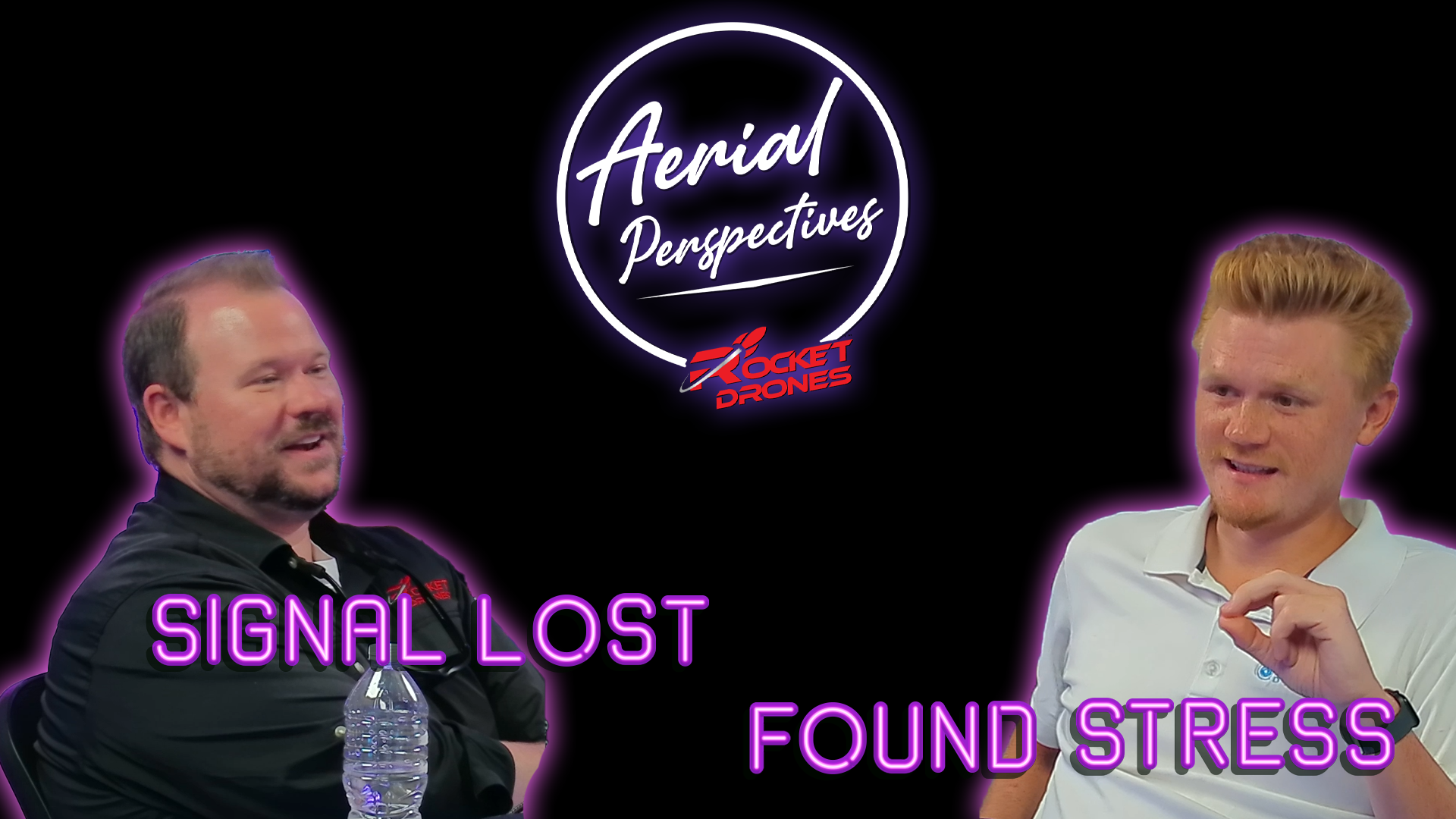
Episode 2: Aerial Perspectives - Military Precision to Commercial Drones
Guest: Mike Haddock (Aerial Photographer, Videographer & Mapping Specialist | JTAC Veteran)
Host: Chris Tonn
Location: Rocket Drones Studio, Florida Panhandle
---
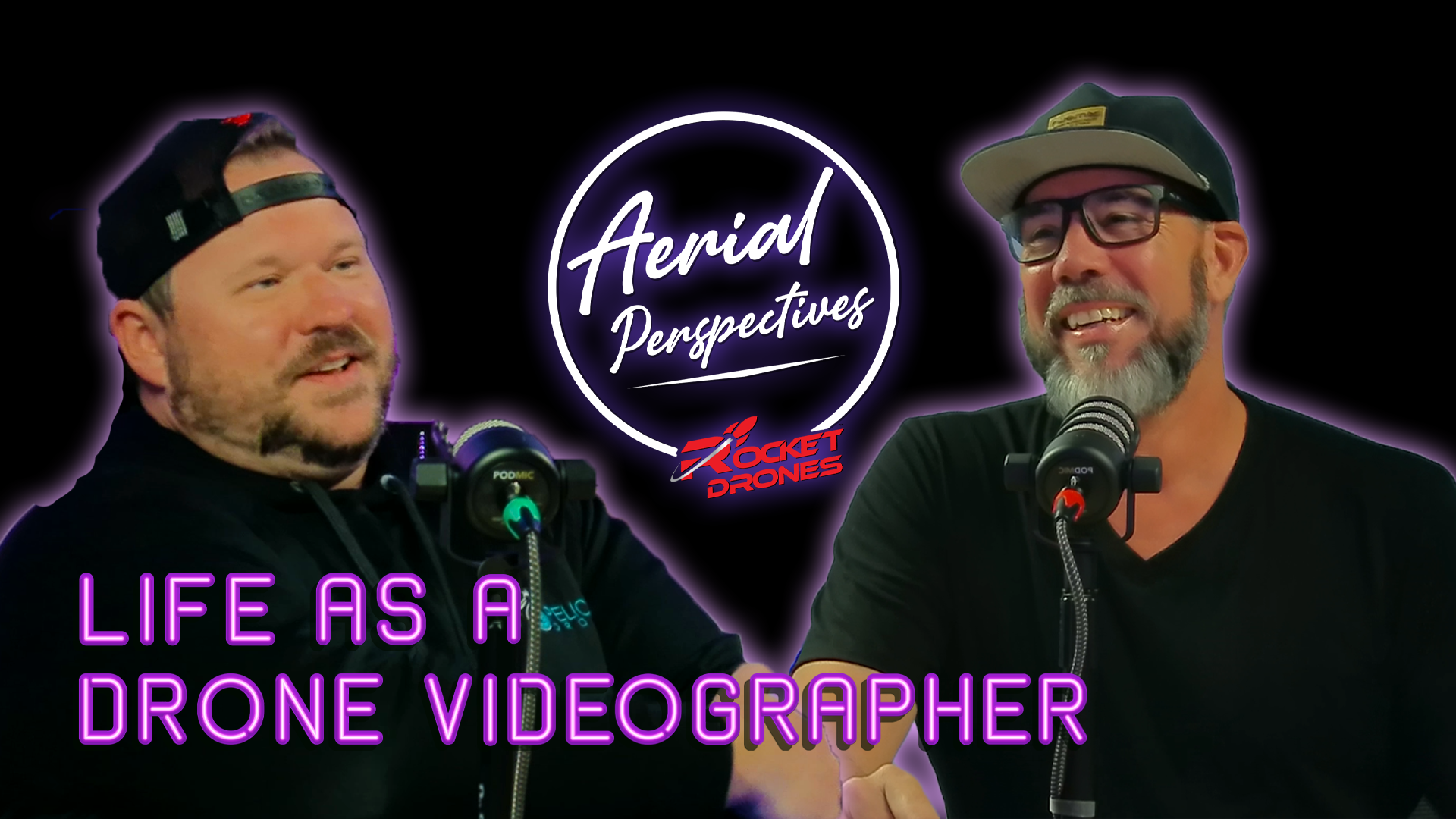
00:00:00 Chris Tonn: So here we are today. Welcome, folks, to the first ever episode of Aerial Perspectives. I'm your host Chris Tonn, and we have a very special guest, Mike Haddock, which we're really excited to have on the show. Mike and I go way back to some beginning chapters of my drone career, and it's always cool to come full circle on some of these stories, so I'll kick it off with a little brief intro with Mike.
We're excited to have Mike, who's a seasoned drone expert with over a decade of hands-on experience in aerial photography, videography, and mapping. Mike began working with consumer drones in 2013 and quickly made his mark in the industry by contributing to the first Unmanned Aircraft Systems Traffic Management initiative in California in 2015.
And with over 20 years of active duty in the Air Force as a JTAC in both conventional and special operations, Mike brings a unique blend of military precision and technical expertise to his work. A true patriot, he's guided by a passion for America and believes no idea is too small, and many have the potential to change the world as we know it for the better.
So with that being said, welcome Mike, and glad to have you on the show.
00:01:15 Mike Haddock: Thanks, Chris. It's kind of weird to hear about yourself like that.
00:01:18 Chris Tonn: It is a little. Thanks to a little assistance from AI and these new chapters, we can get a nice, clean understanding of just some of these bullet points into a nice, simple intro.
But with that being said, I mentioned in the beginning that you have been there since the beginning of my drone career, which started back in 2014. One of the things that was really important back then was that the usage was kind of limited to photography, videography, things of that nature. I think one of our first ever joint ventures was a wedding together.
But I'd love to hear more about how you were first introduced to drones in this space, and kind of how that came to be.
00:02:00 Mike Haddock: Well, I think it was actually a little bit before 2013. I had just retired and I moved back here. Like I said, I was starting my photography career and I was really trying to figure out how to integrate aerial stuff because the rules were—it was cowboys and Indians back in those days.
So we knew what we had to do, strapping on GoPros and not really having a feed to really see what you're looking at to shoot or anything like that. But then I got my first drone from a Navy guy out here, and it was a kit drone. It was like the first Phantom Zero. And he had put this thing together. I don't think he had a camera on it. He had a gimbal on it, but I had to get a camera and figure out that whole process.
So that was my first drone back then, and it just took off from there. And then the networking happened when everybody started seeing me fly drones. Everybody had questions and wanted to get involved. And then before you knew it, everybody was wanting to fly a drone and get involved in it.
00:03:10 Chris Tonn: Yeah, no, absolutely. I can remember—I can still hear it in the back of my head of folks: "Sir, sir, can I ask you a few questions about that drone? That is so cool."
In the beginning chapters, it really was something that just took the breath out of people's sentences. They'd see and hear a quadcopter going off and "Oh my gosh, what's going on here? What are you doing? Is that thing filming? Does it have zoom?" Lots of questions would hit.
Well, tell me a little bit too about—I realized that was kind of when we started to get into the consumer space, but it sounds like you had some exposure pre-consumer days of drones in military days in the Air Force. Do you have a little bit of how that chapter started as well?
00:04:00 Mike Haddock: Yeah. So about halfway through my career, we were responsible for controlling fires off of multiple types of platforms. Ground platforms, artillery, mortar, fixed wing, rotary wing, and then all of a sudden come along the UAS—the Predators was one of the first examples.
We did have smaller internal drones, but I wasn't really around that community as much. And that was still kind of in its infancy as well.
00:04:30 Chris Tonn: Is that like Special Forces back then?
00:04:32 Mike Haddock: Yeah. I mean, guys were not really—they were kind of coming online and learning how to fly those things. So it was really kind of hit and miss if you had one around you. They're everywhere now, though.
But like I said, we were kind of—they were running unilateral operations with the UAS, meaning that we weren't really in direct control of them or communications with the actual operators on the ground.
But that happened quick when they figured out we can talk through SATCOM to them and have a good link of communication with them and talk to them just like a fighter aircraft or a rotary wing asset. And it was really nothing different. They had munitions on them, they had a camera on them, and we directed them. And that was the end of the story.
00:05:20 Chris Tonn: So chapter one, more so locally operated versions of the Predator. And you could kind of see, but you couldn't control. And then later it got more to where you could see and control from satellite-related control systems.
Now I still hear a little bit of that alive and well today with landings and takeoffs because of the latency. Is there still a little bit of that localized takeoff and landing stuff going on?
00:05:45 Mike Haddock: There is. You do have some platforms that have dual communications or multiple types of communicating with them. But the traditional method is through SATCOM, and there's a latency in that. But it has gotten better.
The funny thing about that—when I was just getting ready to retire, there was really heavy talk about actually being able to control certain aspects of that platform, like moving the camera, because that's a very important part of figuring out what's going on.
And that's happened. So in certain areas—it's not everybody has control over it. But I don't think we can fly them now. They still don't relinquish that part. But yeah, it was kind of a cool thing to think of that you could actually move the camera around yourself and look at stuff instead of asking the operator to do that.
00:06:35 Chris Tonn: Absolutely. Was this something that you were drawn to within the military and they gave you an opportunity to apply, or is this something that you were kind of picked and put into?
00:06:48 Mike Haddock: It was just an inherent skill set you had to get, because if you were a JTAC and you were controlling aircraft, that was going to be in your toolbox at that point in time. So you needed to learn how to do that.
So it wasn't necessarily anything special. Those assets are at times allotted to specific and higher echelon units for more important types of operations. But everybody's doing it now.
00:07:15 Chris Tonn: And for those that don't know, a JTAC is...
00:07:18 Mike Haddock: A JTAC is a universal term or an acronym for Joint Terminal Attack Controller. And it's a worldwide qualification now.
It used to be kind of localized to certain American forces specific to the Air Force, too, by the way, until everybody wanted to get their hands in the pot. So they had to come up with a joint way of doing this. So all of our friends across the world have JTACs as well.
But they're essentially responsible for controlling and integrating surface fires, air-to-ground fires primarily, but they do a lot of communication, data links, and they operate high-end equipment that's not necessarily fire support equipment, but a lot of other cool things.
00:08:00 Chris Tonn: So this is almost like the evolution of what was the radio man has now become way more tools in the toolbox of being able to see and communicate back potential coverage of support and other things. So that's very cool. I'm sure it changes every year as we go by—the abilities.
00:08:20 Mike Haddock: It does. And the career field is getting a lot more fast-tracked, too, with those qualifications.
I was one of the fortunate ones—when I first came in at a younger age and a younger rank or lower rank, I was offered the ability to go get that schooling. There weren't a lot of us around at that point in time. I think there was probably maybe a thousand in the total force.
So that was in—I think I got my initial qualification in like '96, and we were called back then Enlisted Terminal Attack Controllers. But you first learned how to—your primary mission at that point in time is to run a radio and establish communications with multiple assets, ground assets, air assets. So you're a radio man pretty much first in that whole career for that progression.
About two or three years later, you were a JTAC or an ETAC. But now they're fast-tracking. It's a whole pipeline now for the kids coming in.
00:09:20 Chris Tonn: That's so cool. Well, it sounds like you get to be a jack of all trades. Short end of it.
00:09:28 Mike Haddock: I think one of the most—the things that I got more comfortable with than anything was understanding the third dimension and looking at assets in the sky and having a feel for that and playing chess, not checkers, with them. And having to think two or three steps ahead.
Because ultimately your job is to clear an aircraft hot to drop munitions or shoot a forward-firing munition. So it was a really cool time in my life. And I think that's what helped me translate easily over to becoming a commercial drone operator in the civilian world.
I was very comfortable with flying these things around and seeing it in the air and knowing where it was at and knowing where I had to come home to and go away to and all that kind of stuff. So it was cool.
00:10:20 Chris Tonn: Well, that's exactly where I was headed with this. It sounds like back then the bug did bite, and obviously stuck around for the introduction of what became the launch of consumer drones. And those consumer drones being able to provide commercial services in the photography/videography world—and that was something you were clearly hungry for.
But tell us how that kind of lined up and also some of the challenges back in the day of just putting a drone up before we had things like Part 107s and stuff like that.
00:10:55 Mike Haddock: Well, I was a photographer first before I was anything. I was a ground guy, had a camera in my hand. I was shooting whatever I could get my hands on at that point in time. And I'm trying to start a business, too, by the way, and I have no idea what I'm doing.
So then the drones came online and I quickly figured out—and I think everybody else figured out very quickly—how valuable they were for marketing assets or just understanding certain spaces for building major complexes or major developments.
Because it's not just shooting a pretty home all the time or a pretty subject or sunset all the time. There's a lot of value in these drones in a lot of other areas too.
So that's one thing that kept me fired up, was that I knew there was value in it, because a lot of times you do things in your life and there's like, "Is this really worth it? Am I really kind of headed in the right direction?"
And I'm not the best decision maker, but I kind of figured the drones were going to be kind of a cool thing in the future, and they're going to be a viable income option, too.
00:12:00 Chris Tonn: Now, absolutely. I was kind of in the same—that bug that bit, it kind of grabbed ahold of me. I think it was partially YouTube to blame at the time. We were starting to see some chapters of early innovators taking home tours to the next level in places like Laguna Beach and big city environments where they just had the budget and the understanding of, "Okay, we have a camera on this thing. Let's fly it through, let's fly it around."
And that was the same time that gimbal technology for cameras was taking a huge leap forward. So you had ground—what was otherwise reserved for Steadicams is now coming to life as a gimbal. And the old-school folks are catching up to this.
But it seemed to open the door for a new age of creativity that said, "Okay, yes, drone is part of this storytelling ability, but now with the understanding of how to do the drone, you can kind of tell the rest of the story of bolting on a gimbal for interior or for testimonials" and so on and so forth.
But did you find that the drone world was something that people automatically and quickly accepted as a service that they would just call about? Did it take you painting the picture over and over again? What was kind of that journey of getting the word out?
00:13:20 Mike Haddock: I guess for me, there was a lot of curiosity. Like I said in the beginning, people were very curious about what this thing was actually used for. There was obviously a lot of privacy concerns, but I'm stubborn and I didn't really let that stuff deter me from going forward with this.
Once I got my first big—I guess my biggest job, my first big job, was a mapping job, and it was like a 70-acre place in the middle of nowhere in Toquerville, Utah. And I kind of didn't know what I was doing. I didn't really know, but it worked. And this is fascinating.
So yeah, I guess there was a lot of head-scratching going on in the beginning days, but I didn't let it get in my way at all. I just knew it was going to be a valuable tool for a lot of different reasons.
00:14:15 Chris Tonn: No, absolutely. That's one of the things that I think is the comfort, the warm blanket feeling when you first step foot into this industry—it's like, "You know what? I may not know where the second or third sale is coming from, but I know this has the potential. I know this has the capability. And if I keep getting the word out, it's just going to continue to catch on."
And thankfully as it's shown, it has. And you stay quite busy—not just here locally in the Florida Panhandle, but also traveling around and enjoying some of the military side of continued connections. So it's nice to see that the demand was right from your initial thoughts.
But you touched on mapping, and I know there was a chapter in your earlier days that you had ventured into a little project with, I believe, our United States government to some understanding of getting better understanding of the drone mapping capabilities. Can you shed some light on that?
00:15:15 Mike Haddock: So I've done predominantly civilian mapping for big developers, whether it be home developers or commercial developers.
I was involved with the UTM process, like you mentioned, in the early days. And that was kind of—I was once again a deer in the headlights. We just got—I got lucky with another counterpart of ours who got invited, a very small company who was going up against—not against—they were working with university-level departments that were working on this traffic management system for UAS, and it was only Phase One.
So that was really interesting. Once I got there and got on the ground and we started doing autonomous operations, it was like beyond visual line of sight. I was like, "Holy cow, you can do this?" They're like, "Yeah." So it was pretty awesome.
00:16:10 Chris Tonn: No, that is. And it's exciting to hear that in the early days, the hunger was there so much that it wasn't always just Boeing or Airbus. It was smaller companies that just had their name in the hat that were ready to participate in these studies. And I assume that that went somewhat well, a good experience?
00:16:30 Mike Haddock: It did. It was awesome. I think we spent three days on the ground and we had—we were the smallest drone there. I can't remember what type of drone it was. It was one of the first original, like 3DR. Yeah, that's what it was, I think.
And there was nothing on it. There was no camera payload. There was, but it just had a GPS and ability to link up with the software system that we were using. We could autonomously plan missions, and we were proving the concept that we could fly around this area and go to certain spots and stop and lower and shut down and come back up without really any human touching except for starting it up in the beginning.
But there were other drones out there that were like, "Holy cow, this thing is alive. They make this kind of thing?" It was amazing. That was in 2015. So I can only imagine what's going on now.
00:17:25 Chris Tonn: Yeah, no, absolutely. That's pretty exciting stuff to think back to. When we were in beginning chapters of—I remember just thinking, "Oh my gosh, can this thing fly longer than ten minutes?"
To now it's like all those systems that you mentioned in experimental phase are now really the norm of how we boot up. And like, "Hey, do you want it to take off for you? Do you want it to go here for you? Do you want it to orbit for you?"
Those were all things that had to be initially mastered from a skill set level early on.
So speaking of, is there like a favorite drone work, mission, or experience that sticks out? Or maybe just a fun project that you just look back on and say, "Wow, that was something"?
00:18:15 Mike Haddock: You know, as you advance in this career field, you're going to be presented with bigger opportunities and they might equal more money, but they usually—for me—require more coordination. Like dealing with the system and dealing with FAA and dealing with local towers and getting authorizations to fly in zero-grid blocks.
So those are kind of—once you do that one time, I got excited. I'm like, "Okay, I can do this now. I don't have to just kind of think I'm doing this the right way or not. I'm going to do it the right way, and it works."
So those kind of processes are becoming interesting to me. And I like that part of the job now where I actually have to file through these websites and get authorizations and word it correctly.
And what's great about it too—you're creating a checklist already through your introduction to the FAA of how you want to actually do something with this project in a zero-grid block. So it helps you follow through with your mission too as well.
But no, I mean, I think they're all kind of just—I won't say they're becoming the same. It's just the uniqueness of traveling around the country and getting down, like for instance, Southern California's airspace and working in that airspace. It's difficult. You never know what's going on down there.
This airspace, we're kind of condensed up here too because you have so much military airspace, but it's not as bad as like Southern California or some bigger metropolises. And those—like I said, they're challenging. They're fun to me, though. I like that part of the job.
00:19:55 Chris Tonn: Yeah, no doubt. You speak of this local market that we're in as a lot of military, and it is. They say it's one of the more layered military airspace corridors with all the training grounds and testing grounds, and spacecraft landing in the Gulf.
So just pick your day and it can be layered for sure. And as you mentioned, when we travel, it does make it a little easier to accommodate what might be a new mission in California or New York. And they have just as many curveballs sometimes as we do, or vice versa. Sometimes it's all clear.
00:20:30 Mike Haddock: Yeah. What's becoming more clear to me—that I do involve myself in that process—is that the tower operations and the local people are becoming more savvy and more—I wouldn't say lenient, but they just want to hear what you're going to do and let them know how you're going to be safe, how you're going to land, how you're going to take off.
And from my experience, I've had nothing but great relationships with the tower people. As long as they know that you've submitted your authorization correctly and you're the person escorted, it works out fine.
But in the beginning, it was kind of like, "No, we're not even going to touch that." And even though I could do it still, but I'm like, "Hey guys, I'm going to be here." But they didn't even have a conversation with you in the beginning. But now it's getting smoothed over a lot better.
00:21:20 Chris Tonn: That's so true. I remember as well the local contacts being a very "Oh, we don't want to touch this. We'd rather you get the regional or DC office to approve this."
And there was kind of—until Part 107—it was kind of a little, you know, "Who and how do we go with some of these requests?"
And thankfully, there has been more light shed on that. I hear now we're in a new chapter of Beyond Visual Line of Sight certification coming out. I believe it's going to be the Part 108, if I'm not mistaken.
But we're continuing to see more and more of this. I think when I first started, it was a 333 exemption and sport pilot license rating or higher and just getting experimental aircraft tail number out of Oklahoma—just lots of layers.
And now it's like you said, you can pick up the phone, we can talk to local tower authority, we can get a better insight of what's going on. And it's become more fluid.
But I look to the future and I have to ask you this too. But where it started for us in some of these photography/videography settings—and now drones have made their way into basically every industry—where do you see the biggest demand for pilots that might be looking to get into the drone space as we continue marching forward? Do you think it's agriculture? Do you think it's more construction, military? Where is really the big push, or is it evenly in multiple industries?
00:22:50 Mike Haddock: Yeah, I think it's spread across multiple industries. I don't know what the numbers are right now, but like AG is big. Power line inspections is big. Construction management is big. And obviously just traditional marketing collateral for your real estate agent or your land developer.
So I mean, I've had a lot of missions lately where I'm actually going out and doing what's called an aerial—not a survey, but an assessment. And it's essentially taking a bunch of pictures at certain elevations on undeveloped land.
But the developer wants to understand what the view looks like, generally speaking, from 40 feet up off the ground. "Is this building going to be in my way? Is that boat barn going to be in my way? Is the boat going to be in my way?" For instance. They want to know that kind of stuff.
But those are becoming really popular. And it's just you're flying your drone around in a grid, shooting photos on the perimeter of it. And it's pretty simple. But those are becoming popular for me.
00:23:55 Chris Tonn: Interesting. It's interesting you say that. I guess I sometimes take for granted how simple I look at some of the offerings within the imagery space, but it's actually grown to be quite diverse in the styles and usage cases of why someone might call for an image request in the first place.
We've seen—like you said—for a property looky-loo kind of side of things, to I've been called out for a traffic study at like eight in the morning. They didn't trust the DOT numbers for the traffic intersection, and they wanted to get real hard numbers on, "Okay, what does it look like every time that light turns red?" And they're thinking of building a fast food restaurant or something like that.
So we've also been dispatched for 360 imagery. So now, as you mentioned, maybe we're just up enough to see what is that third floor or second floor or even fourth or fifth floor view look like. And is it worth me building that extra budget to get higher up and so on and so forth.
So is there anything else that you find to be just a new chapter of the photography or videography sector of drones, or how has it changed in the most recent chapter that you would say?
00:25:10 Mike Haddock: There's been a lot of changes. Obstacle avoidance was a big one. That was a big step forward for us. Image quality—I wish I could be happy with it because I run around with cameras all the time, and I want that same image quality in a lot of these drones. And I'm not getting the same thing that I'm getting with the ground cameras. You can't get them.
But obviously those drones are expensive. If I had my wish, I would strap my R5 on an FPV drone and shoot stills all day with that. I'd love to do that. But that's an expensive chassis, and I'm not quite sure I want to get my Canon up there like that.
So I deal with, you know—the one-inch sensors helped out too. But image quality—it's gotten better because it used to be GoPros really. And they're still there—they're not bad nowadays. GoPros are great. Pretty good image quality.
No, I think like size has gotten a lot better too. A lot more compact and still powerful. Good battery life. It's really hard to say, you know. I mean, you could just throw a dart at the wall, and you could apply a drone to that mission. It just does so many things. So I don't really know. I know DJI is coming out with a lot of cool stuff and so is everybody else.
00:26:35 Chris Tonn: Yeah. Well, you mentioned several there that are just like—I think early on we forget how much we were just hungry for more battery life. What would save us on longer battery life would save us on more batteries in the case, that we're always the heaviest item to travel with.
But yeah, batteries—now I get bored flying 40-minute flight time. You're done in 20 or less most of the time. So it's neat to see.
Well, one thing you mentioned in there too that I think never goes out of style—like with FPV flying, for example, or some of the manual piloting skill sets, which as you know is a big mission at Rocket Drones, one of our educational companies that we push drone training to middle and high school students.
But it's hard to understand what an employer really wants in the drone space. But if you're sitting ready to hire and expand in your drone company, what's kind of the qualities that you're looking for beyond certification when it comes to trusting a pilot in the field? Does that manual piloting element come to mind, or is it other factors that you think of?
00:27:50 Mike Haddock: It is. Because you know, like we grew up—I grew up manually flying. I didn't have buttons and settings and things I could press on my screen to make it do what I wanted to do, but I had to fly that thing manually.
And I still honestly fly manually often. I have a POI button and I probably use that POI thing maybe once or twice, but other than that, I'm flying that drone myself.
So that's definitely a good one to have because you're obviously involved in the mission. You're actually articulating the controls. So that's important.
I would say a good grasp on—like we talked about—the LAANC systems, airspace systems. That can become very intimidating if you don't have a good grasp on that and you're still flying and you might not know if you're doing something right.
Well, just get yourself educated and you're going to be in a lot better position to feel comfortable flying a mission because you don't want to be distracted doing that.
So yeah, definitely a good grasp on systems, FAA requirements for airspace, knowing what a TFR is, knowing when you can and cannot fly when they're there. And really just understanding airspace, period. That would be a very, very good quality to have.
00:29:10 Chris Tonn: Well, that's so true because 90% of your missions as a drone pilot will probably be in controlled airspace. So controlled airspace equals knowing what's going on in that space.
And the manual piloting—we find it all the time where the sensors don't necessarily fail. They're just not compatible with certain scenarios, like being under a tree or being under structure like a bridge. That means you're the one piloting again for the wind that's blowing the drone around, not the computer.
So those are—when it comes to trust factors of an employer handing over the sticks to an employee—that's certainly in the wheelhouse of desirability.
But you bring up a lot of good points there. And I appreciate it, because I think that's really where a lot of our audience is hungry for. What do I need to get stronger at? Is there more going on than a certification? And I think the cert's probably the easiest part of this journey.
00:30:00 Mike Haddock: Yeah. I mean, not to give anything away—the test really wasn't that difficult for me in the beginning, as I was one of the first ones to take it, I think. And I was a little stressed out, but I walked away from it going, "Man, that was no reason to stress out."
But in keeping up with the trends, especially back again with the airspace, because that stuff changes every six months. Something new is introduced. Maybe there's a new LAANC system that you need to know about that wasn't there in the past. Your flying areas—there's technology advancements that could help you out. You need to keep up to speed on that kind of stuff, too.
So becoming members of the prominent Facebook groups—there's a lot of good information out there, a lot of bad information too, by the way. But there's a lot of good information out there, a lot of people out there who are way more experienced than I will ever be, and I rely on them a lot to help me kind of navigate through those fields.
But yeah, get your head wrapped around airspace and authorizations and it's going to make your job a lot funner.
00:31:00 Chris Tonn: I love that. And hey, another one—maybe go to a drone trade show out there too. Get your—physically go out and see and talk and experience some of these.
There's one that comes to mind, I know, is one that's been a nice neutral resource of drone technology. And they don't just focus on the stuff that flies. I know they're on the underwater and the space and everything else in between. So that's another good resource to look at.
00:31:30 Mike Haddock: But I know that in my photography profession, I involve myself in a lot of workshops with other professionals, whether it's on-site or I'm paying for a course.
Those have become so valuable to me and my advancements and how I get better at my job and better my client relationships, too, by the way. Because those are so important—how to deal with the client when things are going good and things are going bad too.
But yeah, get yourself involved in the communities, online communities. And if you have to lay down four or five hundred bucks to go to a workshop, a real live workshop, that's invaluable.
00:32:10 Chris Tonn: Couldn't agree more. It's one thing to be a great pilot, but if the payload that you specialize in being a camera and you're shooting straight into the sun and you haven't learned that chapter of the do's and don'ts of the camera, that's going to be an important one to also get caught up on. I greatly appreciate you bringing that to light.
00:32:30 Mike Haddock: Yeah. And realize if you run downwind at 35 miles an hour, you got to come back upwind. Your battery's not going to like that too much. You're stuck.
00:32:40 Chris Tonn: Yep. No, absolutely.
Well, good stuff. Mike, I oftentimes try to focus this show on helpful information that is going to benefit our viewers that are interested in getting into this drone space. And I think that this is a really nice opener to some of those ideas that can lead to, one, the beginning chapters of photography and videography, but also much, much more.
And to kind of keep their eyes and ears open to these opportunities. Is there anything else that you'd like to add as we kind of close out—for advice to folks that are, again, interested in this industry and getting their hands dirty? Is there just a good starting point that you like?
00:33:25 Mike Haddock: Well, first of all, it's a saturated market right now. That should not be a deterrent because a lot of that saturation is just fluff right now.
You got to stick with it too if you're really into it. You got to stick with it. It's taken me ten-plus years to even feel like I have a business now. And before, honestly, it was not like that. It was a lot up and down. It was feast or famine for a long time, but it just takes time.
So stick with it and keep yourself educated. That ten-thousand rep thing is true. It's going to take you at least that long to get good at what you're doing. So stick with it. And just go for it, though.
00:34:05 Chris Tonn: I love it, Mike. That's such good advice. And appreciate you coming on the show to share it.
00:34:10 Mike Haddock: You bet, man. Thanks for having me. I appreciate it.
00:34:13 Chris Tonn: Absolutely. All right, with that, we're out.