Drone Certification: The Job Skill Your Students Can Use In Any Career

red ball print on transparent image

Your students finished a career readiness program, earned a certificate, and still can’t point to a single job skill an employer would pay for. That’s the problem most job skills for students programs run into. The training checks a box, but it doesn’t translate to the workplace.

Drone certification is different. It’s a federally recognized credential that students as young as 16 can earn. And it applies to construction, agriculture, public safety, real estate, and dozens of other fields. It’s a skill employers are actively hiring for.

This article breaks down what drone certification involves, which industries are moving toward it as a standard expectation, and how to build it into your CTE program.

What Job Skills Do Students Learn With Drone Competency

Earning drone certification means students develop a specific set of skills they can transfer into the field. 

  • Flight Proficiency: Hands-on experience to operate a drone safely and confidently in real field conditions.
  • FAA (Federal Aviation Administration) Airspace Knowledge: Understanding airspace classifications, flight restrictions, and regulatory requirements for any commercial drone role.
  • Safety Protocols: Demonstrating safety practices before, during, and after flight operations, including preflight inspections and emergency procedures.
  • Data Collection and Interpretation: Collecting usable aerial data and understanding what it means in a field context.
  • Mission Planning: The ability to plan a flight path, assess site conditions, and execute an operation with a clear objective.
  • Equipment Maintenance: Having basic knowledge of drone mechanics, troubleshooting, and preflight checks.

Industries Where Drone Skills Give Students a Competitive Edge

Twenty years ago, computer literacy shifted from a competitive advantage to a job requirement. Drone competency is on that same path, and these industries are leading the shift.

Aviation

Airlines, charter operators, and airport management teams are expanding their use of drones for runway inspections, perimeter security, and cargo logistics. Students interested in aviation careers can use drone competency as a practical credential.

Construction 

Site managers rely on drones for progress monitoring, volumetric measurements, and safety inspections that used to require scaffolding or manned aircraft. A project engineer who can also fly a drone for site surveys or progress documentation reduces the company’s need to subcontract that work out, which saves time and money on every job. 

As data-driven jobsites become the norm, construction firms are looking for new hires who can operate drones alongside their core responsibilities. For students entering this field, drone certification signals that they bring a skill most candidates don’t have yet, and one the industry is actively building around.

Agriculture

The U.S. agricultural drone market is projected to grow at 23.5% annually through 2030. Mid-to-large-scale operations already use drones for precision spraying, crop health imaging, and field mapping. As these tools become standard, students pursuing agriculture careers will need drone skills to stay competitive.

Public Safety

Fire departments, search and rescue teams, and law enforcement agencies are building out drone programs at the county and municipal levels. For example, drones are now used for traffic monitoring to collect real-time data on traffic flow and road conditions. 

Infrastructure and Utilities

Power companies use drones to inspect transmission lines, cell towers, and solar farms. These inspections used to require bucket trucks, scaffolding, or helicopters, all of which cost more and put workers at risk. Drones cut inspection times from days to hours while keeping crews on the ground. 

Departments of transportation use them for bridge assessments, road surveys, and post-storm damage reports. As these agencies build out their drone programs, field roles in energy and transportation will increasingly expect operators who can fly, collect data, and deliver usable reports.

Logistics and Warehousing

Logistics and warehousing operations are adopting drones for inventory tracking and facility monitoring. Large distribution centers are moving toward automated aerial systems, and operators who understand drone technology are in demand.

Environmental Compliance

Environmental teams use drones for site surveys, emissions monitoring, and habitat assessments. As regulatory requirements tighten, the ability to collect accurate field data quickly is becoming a core part of the job, and drone competency is central to that.

Common Assumptions Educators Make About Drone Training

Despite the wider use cases of drone technology, here are some assumptions educators make about drone education:

Drone Competency Is Only for Tech Students

When drone education is labeled as a tech elective, it attracts a narrow slice of the student body and competes for a narrow set of resources.

Drone certification is a cross-disciplinary skill that any student can pick up. For example, an agriculture student can apply drone skills to precision crop mapping. A media arts student can use aerial imaging for storytelling. 

The right program can help students learn how to apply this technology to their career pathway. When educators see it that way, the pool of “right fit” students gets a lot bigger.

Drone Programs Are Too Complex for a Standard Classroom

Many administrators assume drone education requires specialized facilities or infrastructure that their schools don’t have. That assumption keeps a lot of programs from getting off the ground before they’re even proposed.

But structured programs are designed to work within existing classroom environments. The curriculum is age-appropriate, the flight components are manageable, and educators can scale the program to fit the resources they already have.

How Rocket Drones Prepares Students for Real-World Careers

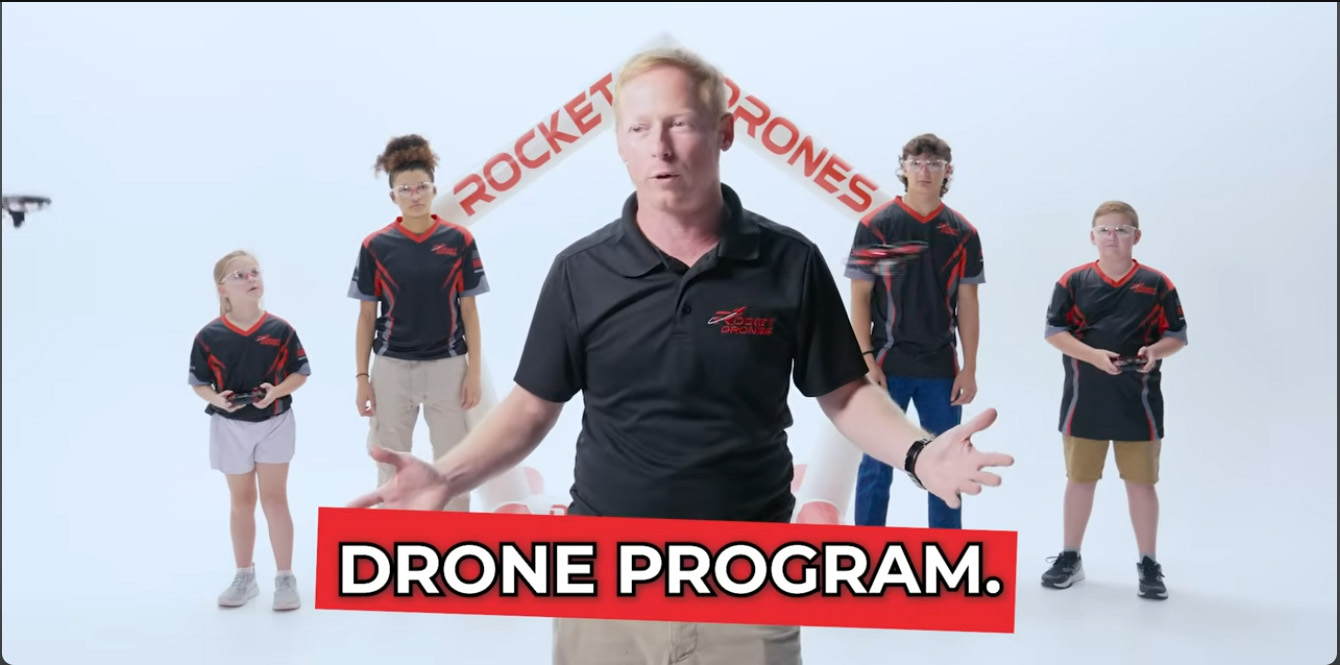
Rocket Drones is a drone education company built for grades 3 through 12. It offers curriculum, instructor training, and student certification so schools can integrate drone technology into CTE, STEM, and other classroom programs. 

Rocket Drones offers a drone certification pathway integrated into your curriculum, allowing your students to develop job skills and connect with real-world industries.

Here’s how Rocket Drones helps students establish drone competency as a versatile career:

FAA Part 107 Certification Training

Rocket Drones prepares students to pass the FAA knowledge exam and earn their Remote Pilot Certificate. The program covers everything the FAA exam tests, including airspace classifications, weather, safety protocols, and flight operations.

The course can be completed in as little as 10 days or spread over 30 to 60 days when taught twice per week. That flexibility makes it easy to fit into existing course schedules without restructuring your program.

Age-Appropriate Curriculum

Rocket Drones curriculum is designed with age-differentiated lessons that build foundational concepts in earlier grades and advance into career-ready skills by high school. 

Professional Portfolio Building

Rocket Drones helps students build logged flight hours and a professional portfolio alongside their certification. That gives them something concrete to walk into an interview with, beyond just a certificate on paper.

Flexible Classroom Implementation

Our drone certification is built to work within your existing CTE programs without requiring specialized facilities. Schools can run it as a fast-track program or integrate it into a broader drone curriculum, making it practical for districts of any size to launch and sustain.

Give Your Students a Skill That Works Across Industries

As drone technology becomes standard across construction, agriculture, public safety, and other fields, students who earn certification now will enter the workforce with a credential most of their peers don’t have. They’ll also carry practical skills like mission planning, data collection, and hands-on flight experience that apply from day one, regardless of which career they choose.

Rocket Drones makes this possible for grades 3 through 12 by combining certification training with logged flight hours and professional portfolio development, all within your existing classroom structure.

Contact us to see how Rocket Drones helps you build a career-ready drone program in your school.

Frequently Asked Questions

Who can earn the FAA Remote Pilot Certificate?

According to the FAA, high school students aged 16 or above can take the FAA Part 107 knowledge exam and earn their Remote Pilot Certificate.

Do teachers need drone expertise to deliver a drone certification program?

Not necessarily, but they do need resources and knowledge to deliver the program. Rocket Drones offers instructor training and professional development that equip teachers with everything they need before the first class. Educators can use structured lesson plans, flight training support, and ongoing resources to deliver the curriculum without prior drone experience

Nationals 2026
is around the corner.

Rocket Drones logo representing Drone Racing for Education, Schools, STEM Kits, and CTE Drone Certification & Curriculum.

Aerial Perspectives Podcast

Discover the exciting world of drones with Aerial Perspectives! Each episode takes you behind the scenes with drone pilots from diverse industries–cinematography, construction, inspection, agriculture, and more.